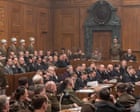
Taking place in the wings of the Nuremberg trial, this Soviet-side political thriller, first released back in 2023, features a scene in which the crowd turns on a boa-draped Hollywood floozy in town to entertain the troops. A case of mea culpa for director Nikolay Lebedev, who trivialises the momentous issues emerging from the courtroom by dressing the legal stuff up with a tenuous and shakily handled plotline about a missing soldier, in an attempt to make his film the Russian answer to Saving Private Ryan. After his brother goes MIA in the vicinity of the soon-to-be-historic city, Red Army intelligence officer Igor Volgin (Sergey Kempo) wangles a post translating for the Soviet delegation.
He’s approached by Lena (Lyubov Aksyonova), a Russian wastrel with a perfectly coiffed bob despite months of forced labour in a German munitions factory; she claims to have run into his sibling, an artist, in captivity. But she is also feeding information to Helmut (Wolfgang Cerny), a Nazi resistance diehard who believes Göring (Carsten Norgaard) and company should be accountable only to German courts. A serious film unveiling the Soviet perspective on the trial, to accompany the likes of last year’s Russell Crowe vehicle Nuremberg, would have been fascinating.
But if Lebedev felt his thriller needed a compelling personal throughline, Volgin’s quest isn’t it; the manhunt is only tangentially tied into the Nazi network, via a connection to art connoisseur Helmut that is mostly there to enable platitudes about beauty transcending war. And the underground elements are erratically threaded through to the bigger judicial picture, with Helmut’s attempt to reach Göring by blackmailing a key witness seemingly forgotten about by the end. Despite his track record with Russian blockbusters, Lebedev struggles to find a confident foothold in this haphazard web of intrigue.
His twitchy camerawork can’t sit still, as if preferring the epic vistas of blitzed cityscapes over his protagonist. Without being overtly propagandist (despite its Russian state backing), the film displays a strain of maudlin patriotism – insisting how the Soviets are disdainfully treated by the allies and slandered by the Nazis at the tribunal – at odds with the film’s message: that Nuremberg was a moment when universal human justice took precedence over national interests. Not a capital crime, but Lebedev is unconvincing taking the stand.
Extract — continue reading at the source.

.png)