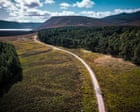
In the Cairngorms national park, the bracken is changing from dark green to russet and umber. Birch leaves are lined with gold, while the Scots pines remain proudly green. Autumn is arriving with a little sigh of relief here, after a summer few will forget.
The wildfire that began near Glenmore and Abernethy on 15 July burned more than 33 sq km (13 sq miles) of moorland and forest. More than 500 firefighters were involved; homes and businesses were evacuated; and the emergency response lasted over a month. Visiting now, it’s hard to see, or even imagine, the damage.
Much of the burned area is high on the hill and far from the roads. It’s a huge loss but, in a national park stretching 4,528 sq km (1,748 sq miles), surprisingly easy to miss. I have come with a gravel bike to retest new bikepacking routes with Kees Wouters and Yannick Ferbeek from Legendary Rides, which offers self-guided tours, and Bikepacking Scotland founder Markus Stitz, who helped develop the routes.
I arrive in Aviemore from Edinburgh on an electric Ember bus, which allows bikes to be booked on board, a welcome development in Scottish public transport. Soon I’m heading out of town through heather and Scots pines, my bike bags stuffed with everything I need for the next few days. The original route would have taken us through Glenmore, past Loch Morlich and Ryvoan bothy, but there are still path closures.
Instead, we take a new line towards Nethy Bridge. Sunlight falls through birch and rowan and the track is soft with pine needles. At Loch Garten, where ospreys nest in spring and summer, it is hard to imagine the smoke and helicopters of July.
Graham Niven lives in Nethy Bridge with his wife, Amy, and runs the self-catering business Arbor Nethy beside the forest. He joined the local volunteer firefighting effort coordinated by the RSPB, part of a huge community response. The Abernethy forest is ecologically rich, filled with ancient Caledonian pine trees that are hundreds of years old.
Extract — continue reading at the source.