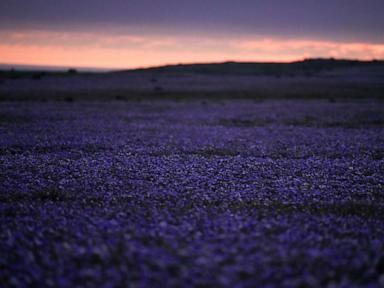
Spring has arrived in the Southern Hemisphere, and even Chile's Atacama Desert is blossoming THE ATACAMA DESERT, Chile -- Spring has finally arrived in the Southern Hemisphere and, in Chile, even the desert is blossoming. Known as the driest nonpolar desert on Earth, a massive portion of the Atacama Desert has been covered in flowers after the El Niño weather pattern brought heavy rains to the region earlier this year. The unusually large amount of water allowed millions of seeds and bulbs to sprout and bloom, many of them after remaining dormant for decades.
Although flowering is common during the transition from winter to spring, this year the rocky, brownish dunes that make up the desert’s traditional landscape have turned into a vibrant, colorful carpet of wildflowers during a historic Desierto Florido, or “flowering desert.” “I always thought it was just going to be brown. That’s my image of a desert, just brown,” said Felix Banda, 51, who was born in Chile but has lived his whole life in Australia. Between July and August, Chile recorded record rainfall in several regions, with some levels never seen since measurements began in the 1950s.
The heavy precipitation was driven by a super El Niño, a climate phenomenon that causes sharp rises in global temperatures and is becoming increasingly strong. In the north, they have also enabled the historic desert bloom, with an estimated coverage of some 17,000 square kilometers (6,560 square miles) this year. This area is similar in size to the Santiago Metropolitan Region, the country’s largest and most populous area.
According to CONAF projections, this is expected to be the most intense and extensive Desierto Florido since 1997. That's because, Pizarro said, the heavy rainfall activated the desert’s biological material, known as germplasm. This includes seeds, bulbs, and tubers but also the eggs of various invertebrates and reptiles.
The result is a true visual spectacle featuring more than 200 species of plants and flowers in a variety of colors, shapes and forms. Red and yellow ñañucas, purple rock purslane, white suspiros, orange terciopelos and the native garra de león, one of the desert’s most iconic species, have transformed the hills, plains and ravines of the Atacama. The hills this year are the best example of that.” Whether arriving from within Chile or overseas, tourists are venturing into the remote, inhospitable areas of the Atacama to admire the millions of flowers adorning vast areas of the desert, stretching from the coast to the horizon.
According to data provided to the AP by the National Tourism Secretariat, the Atacama region is expected to see nearly 300,000 overnight trips by the time the natural phenomenon ends in November, positioning Desierto Florido as one of the region’s main tourist attractions this season. Chef Franco Moya, 37, and his girlfriend traveled nearly 1,000 kilometers (about 620 miles) from Santa Cruz, a town in central Chile’s Colchagua Valley, to several parts of the desert to celebrate his birthday.
Extract — continue reading at the source.