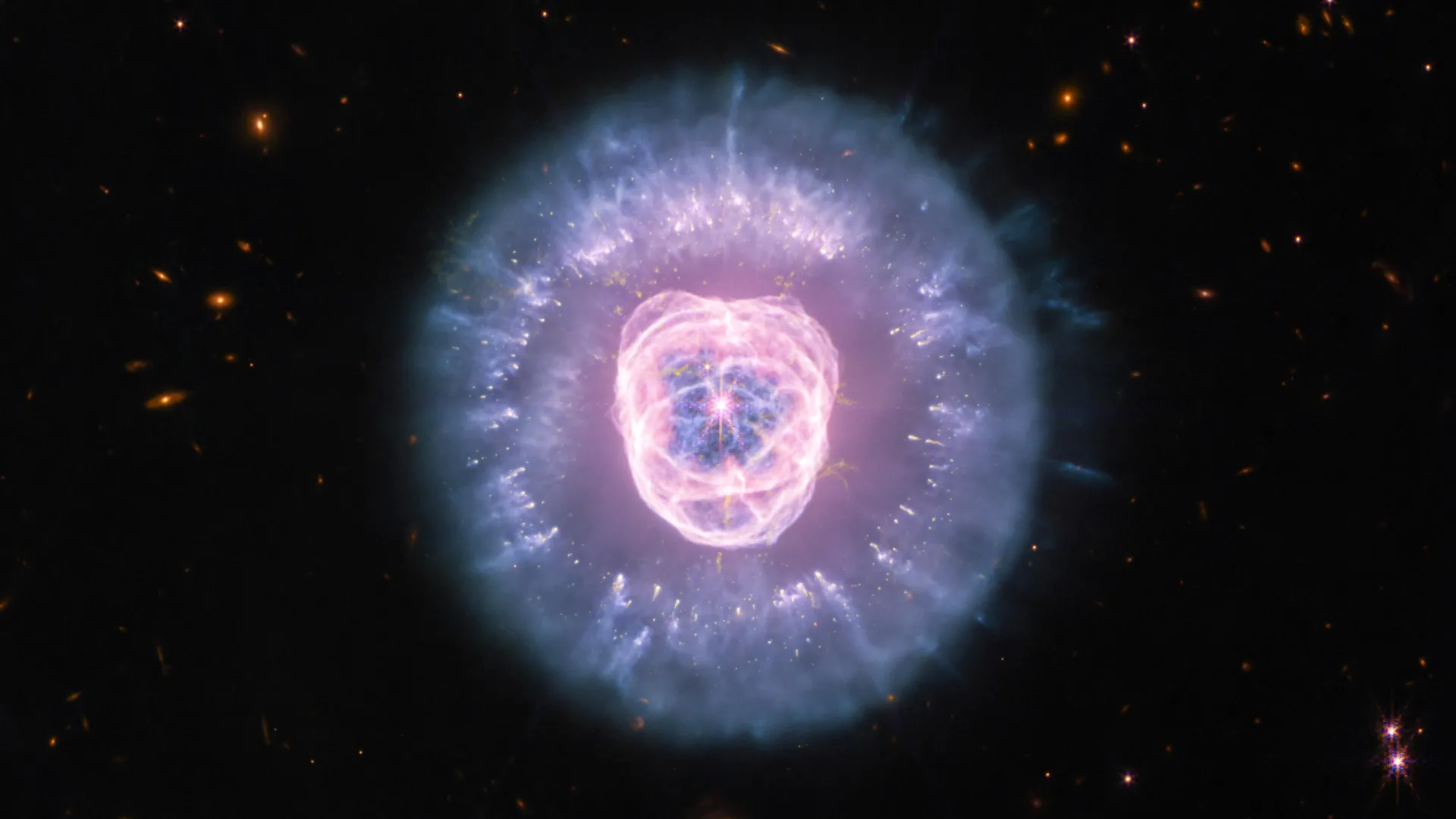
The Hubble Space Telescope previously observed the nebula in 2000, imaging the lion face-shaped target in visible light. Those observations highlighted its distinctive appearance, including a "mane" made up of hazy structures resembling comet tails. Webb's high-resolution instruments now provide an even sharper look at the same object.
Webb Reveals Hidden Details in the Lion Nebula In broad terms, the Lion Nebula looks similar in Webb's infrared observations to the structure seen earlier by Hubble. Webb observed it with both NIRCam (Near Infrared Camera) and MIRI (Mid Infrared Instrument). Its infrared capabilities, however, bring out features that are harder to see in visible light, including dense concentrations of dust and hazy regions of ionized gas.
The gas and dust now forming the nebula have been evolving for several thousand years. Even today, those materials continue to shift and change. At the center of this activity are the remains of a dying star.
In the lion-shaped appearance of the nebula, this stellar remnant resembles a small button nose. Despite its modest appearance, the star's radiation and energy are responsible for driving many of the complex structures surrounding it. How a Dying Star Created the Cosmic Lion Very massive stars can end their lives in supernova explosions, but such events are relatively uncommon.
Most stars in the Universe have lower masses, including the star that created NGC 2392. When a lower-mass star reaches the point where nuclear reactions in its core can no longer support it, the star becomes unstable and begins to pulsate. As this happens, it sheds its outer layers into space.
Those expelled layers form expanding shells of gas and dust known as a planetary nebula (stars at this life stage are responsible for producing much of the Universe's observable dust). Radiation from the exposed stellar core pushes the discarded material outward. What remains at the center is an extremely hot stellar core called a white dwarf.
Extract — continue reading at the source.