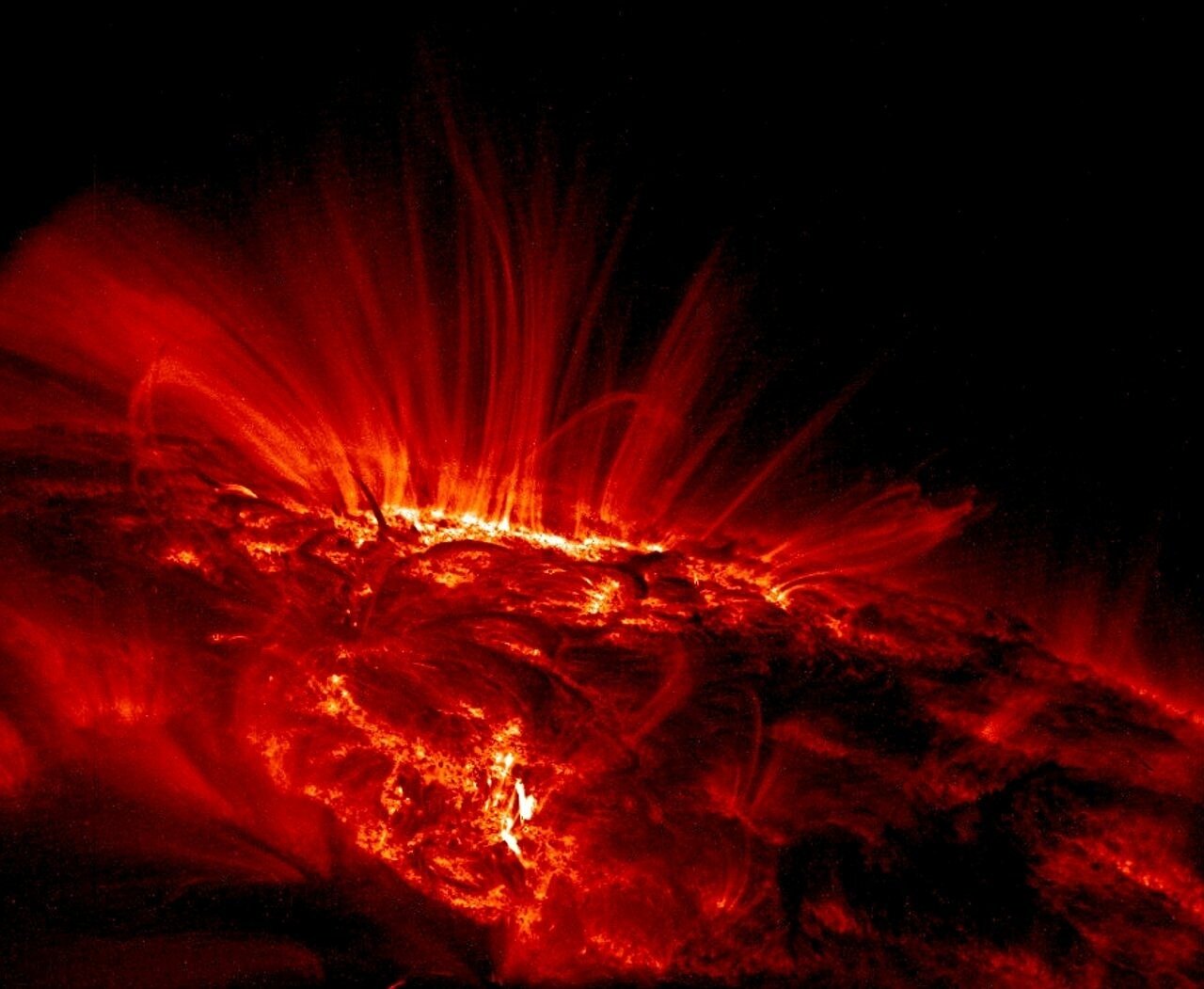
This article has been reviewed according to Science X's editorial process and policies. Editors have highlighted the following attributes while ensuring the content's credibility: Magnetic reconnection is a process that occurs when the magnetic fields of a conductive plasma quickly rearrange and release massive amounts of stored magnetic energy. It is widely thought to be the underlying mechanism behind cosmic events such as solar flares and substorms in Earth's magnetosphere.
Now, researchers from Kyushu University have used high-power lasers to recreate and investigate this puzzling physical phenomenon of magnetic reconnection in a controlled environment. Their results indicate that fast magnetic reconnection is governed by the local physics of the reconnection layer rather than the properties of the surrounding plasma. Briefly, magnetic reconnection involves the splicing and reconnection of magnetic field lines pointing in opposite directions as two plasma flows meet, causing plasma heating and high-speed plasma outflows.
Although scientists have studied magnetic reconnection through space observations and computer simulations, important questions remain unanswered. In particular, it was unclear how strongly the reconnection process depends on the conditions of the plasma flowing into the reconnection region. Understanding this relationship could help explain why magnetic reconnection rates appear to take a "universal" value.
In the present study, a research team led by Associate Professor Taichi Morita from Kyushu University's Faculty of Engineering Sciences, in collaboration with researchers from Osaka University, employed lasers to produce interacting plasmas and probe their magnetic reconnection processes. The study was published in the journal Physical Review E. Using the Gekko-XII laser at Osaka University, the team fired high-power laser beams at two separate spots on a carbon target, producing two expanding plasma clouds.
As the two plasmas collided, their magnetic fields reconnected. By changing the distance between the two laser spots, the researchers could substantially vary the density and magnetic field conditions flowing into the reconnection region. To follow the process, they developed a two-directional laser Thomson-scattering system, which analyzes laser light scattered by the plasma to measure properties such as temperature, density and flow.
The results show that even though the expansion and transport histories of the magnetic fields and reconnection timings differed substantially, the reconnection rates were strikingly similar once a current sheet had formed. "Our study provides experimental evidence for the robustness of the magnetic reconnection process by demonstrating that fast reconnection can occur at similar rates despite substantially different upstream conditions," Morita said. The researchers also quantified how the released magnetic energy was divided between heating the plasma and accelerating it into high-speed flows.
Extract — continue reading at the source.


