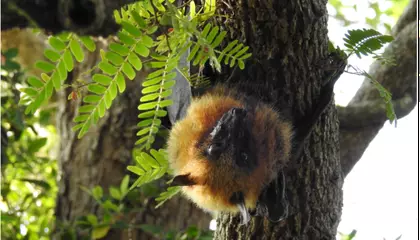
With wingspans up to five feet, Malagasy flying foxes—among the biggest fruit bats in the world—dominate Madagascar’s skies. But new research suggests that these massive, airborne mammals may not be the behemoths they once were. In a study published in the Journal of Mammalogy on Thursday, scientists found that Madagascar’s flying foxes (Pteropus rufus) may be shrinking in size.
The team compared skeleton measurements of modern bats to specimens in various museum collections dating back 150 years. The result: Modern flying fox skulls are noticeably smaller than skulls of their historical counterparts—and human hunting may be to blame. The project began in 2021, when Field Museum post-doctoral researcher Emily Cornelius Ruhs, the paper’s lead author, heard a colleague say that the flying fox skeletons in the museum’s collection seemed bigger than the bats she was encountering in the field.
Intrigued, Ruhs proposed digitizing the Field Museum’s records to analyze how the mammals’ size might have changed. He suggested visiting other museums, too, and assessing the size of specimens in person, which would be more precise than studying the records they had on file. Comparing modern and historical skeletons would “actually test whether or not the skull and the dental measurements are changing in size through time,’” Ruhs adds.
Goodman, a field scientist at the Field Museum and a co-author of the study, examined 121 Malagasy flying fox specimens housed across nine museums in both the United States and Europe. He took measurements of 12 different features of the bats’ skulls and teeth, and Ruhs then analyzed the results. They noticed a significant shift in size around the 1980s: Bats collected prior to that date had skulls an average of 6 percent longer than those collected after, Jake Buehler reports for Science News.
Ruhs says this lines up with the beginning of commercial hunting of flying foxes, which are a food source in Madagascar. Before the 1980s, flying foxes were hunted and eaten on a small scale—to feed a family or local village, she says. But the rise of commercial hunting saw the bats “brought to market and being more readily available on things like restaurant menus in certain locations.” It’s “not this big conglomeration that you’re seeing in the U.S. of food being shipped everywhere,” she explains, but it still put pressure on the animals’ population.
Climate change or deforestation may have also played a role in the shrinkage, but Ruhs says the timing points to hunting as the culprit. The work doesn’t prove that hunting has made the bats smaller. But Ruhs says it’s likely that hunters are targeting the bigger, more mature bats, which offer more meat.
Extract — continue reading at the source.