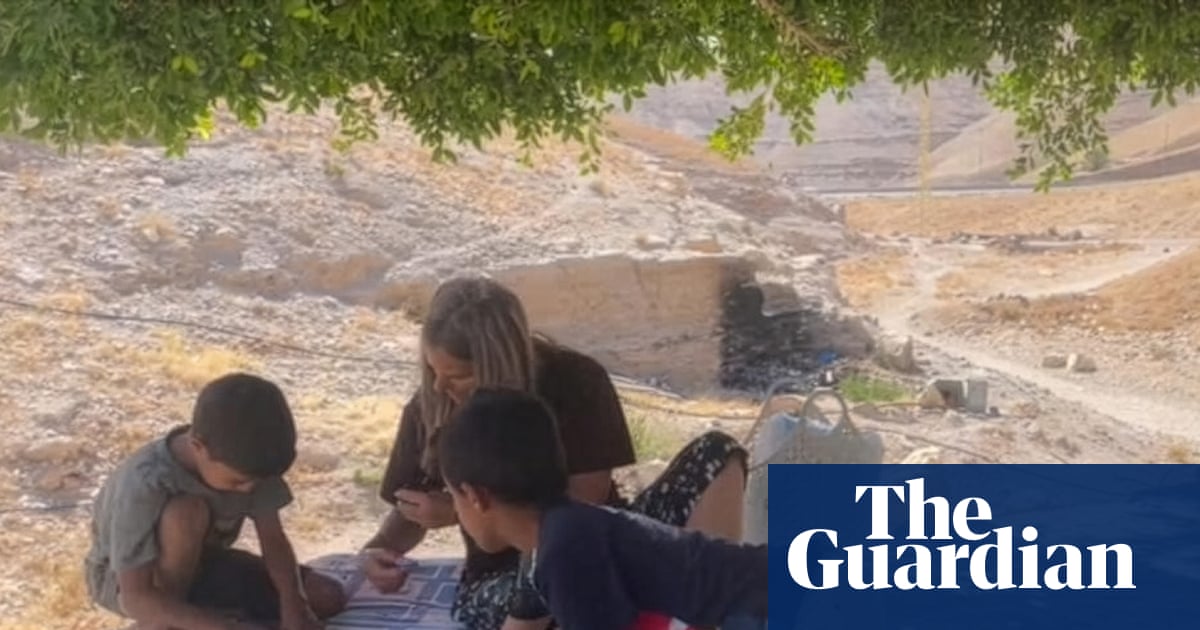
The Palestinian village of Khan al-Ahmar sits off dust-blown Highway-1, between Jerusalem and Jericho in the Israeli-occupied West Bank. At the village centre is the “school of tires”, a fragile construction of rubber, wood and adobe which is attended by around 300 Bedouin boys and girls. The Israeli authorities denied the villagers an official building permit and ruled that the entire settlement is illegal.
For the past eight years the school has been operating under threat of imminent demolition, a symbol of resistance to widespread settler violence. It is only international pressure, says the veteran Israeli writer-director Amos Gitai, that has kept the place upright and still open. It is a test of how far the international community will go [to protect the rights of the people of Khan al-Ahmar].
For once, on this issue, Europe stood up and said no.” As for the future, who can tell? Khan al-Ahmar’s “school of tires” provides an anchor of sorts for Gitai’s The Road to Jericho, a fluid, haunting documentary that elects to frame fraught recent history as a great tidal churn. In tackling the issue of the occupied West Bank, 75-year-old Gitai is also exploring his own role as a ringside observer and frequent commentator, delving back through the bulging back catalogue of a director who the critic Michael Atkinson dubbed “Israel’s one-man New Wave.” His film stirs a documentary portrait of the school with ghostly footage from the past 40 years.
So we see a clip of the playwright Arthur Miller from Gitai’s 2001 drama Eden, plus archive interviews with Shimon Peres and Yitzhak Rabin during the golden false dawn of the mid-90s Oslo accords. The future, Gitai admits, looked altogether brighter back then. The wise heads, by and large, have since left the building.
He wanted an agreement and was prepared to put all the questions on the table and discuss them [because he knew that] you cannot force an agreement. An agreement has to be agreed upon.” And now? So this is, absolutely, the worst time I’ve known in my life.
Many of us in Israel have been living these last three years in a state of shock at the levels of violence and savagery we are seeing.” The Road to Jericho is one of several pictures at this year’s Venice film festival that explicitly focus on the Middle East. NAZA, a co-production with the Guardian that plays in the main competition, spotlights the Israeli military’s role in the mass killing of Palestinian civilians. Raj’in (We Shall Return), a VR documentary about ethnic cleansing in the West Bank, is a harrowing highlight of the Venice Immersive section.
Extract — continue reading at the source.