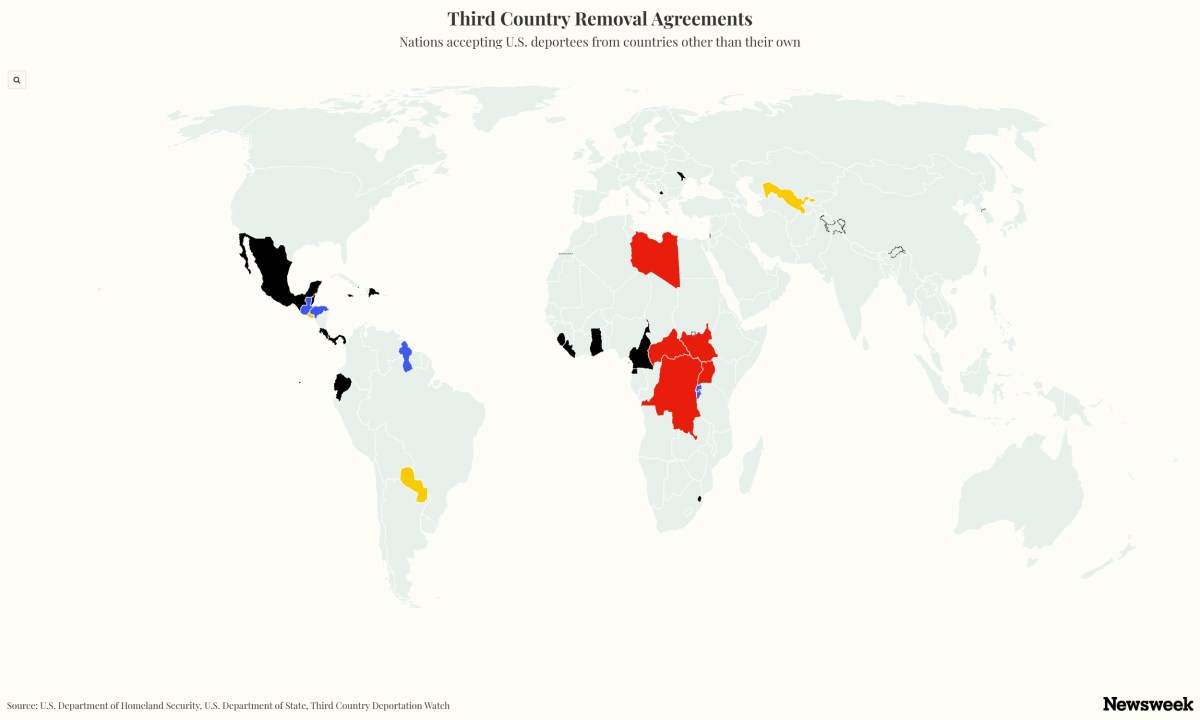
At least five countries on a list the United States can continue deporting immigrants to, despite not being their home country, have the highest travel warning level issued by the U.S. On Tuesday, the Supreme Court lifted a ban on the Department of Homeland Security (DHS) from deporting individuals to so-called third countries. The decision, issued without an opinion, also saw the justices grant a petition for a writ of certiorari, meaning they will hear the case.
Human rights groups have repeatedly warned that immigrants deported to third countries are being put at risk of harm, while others simply do not have any connection to the place they have been sent. "The Supreme Court has now allowed the administration to resume sending people to third countries where they may face persecution, torture, imprisonment, or other grave danger," Trina Realmuto, of the National Immigration Litigation Alliance, which brought the case, told Newsweek. "That is a devastating result as people will be deported under a third-country removal policy that two federal courts already have found unlawful.
But today’s order does not decide that the government’s policy is lawful. The Court will hear that question on an expedited schedule." Third country agreements allow the U.S. government to deport immigrants to a country other than where they hold citizenship or originated from. These cases often arise when the person's home country refuses to take them, a court order bars the U.S. from sending them home, or DHS identifies another country willing to accept them.
Such agreements have been around for several years, with previous administrations, including under former President Joe Biden, working with Mexico, Panama, and others willing to accept deportees. The U.S. has often struggled to deport immigrants from China, Cuba, Venezuela, and other countries with which it has strained diplomatic relations. Under the Trump administration, the list of third country agreements has grown rapidly, with some deals including financial incentives for the third country.
The safety of the countries which have joined the list has frequently been called into question, including by those who launched the legal challenge that has now made its way to the Supreme Court once again. Of the 30-plus countries on the list, Amnesty and Third Country Deportation Watch say nine have a Level 3 or Level 4 travel advisory from the U.S. State Department, with Level 4 meaning Americans should not travel to that country.
Those two categories usually mean a country, or part of it, is facing significant unrest, political uncertainty, violence, or other widespread crime. So far, it is estimated that over 25,000 people have been sent to the countries on the map above since February 2025. Some reports from deportees sent to third countries have included alleged violence from either government officials or locals.
Extract — continue reading at the source.