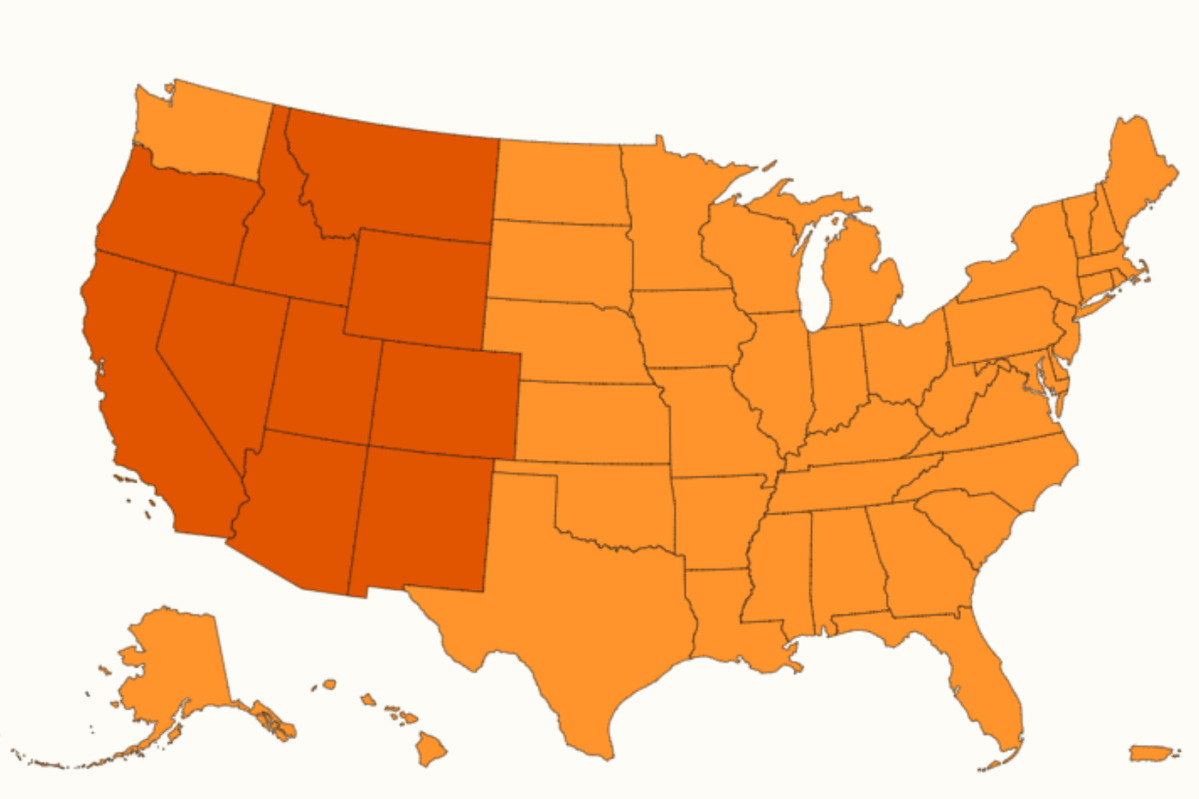
A map shows where America’s federally managed wild horses are found, with Nevada home to by far the largest population, as the Donald Trump administration has moved to shift how the animals are managed. The Bureau of Land Management (BLM) estimates there are more than 60,000 wild horses across 10 Western states, with Nevada accounting for more than half of the total. The numbers come into focus as federal sales of protected wild horses, once a rare occurrence, have increased under the Trump administration, fueling concerns among animal-welfare groups that some could ultimately enter slaughter channels after being sold through a government program.
Newsweek contacted the BLM via email on Friday for comment. Nevada had an estimated 37,426 wild horses, more than five times the number recorded in the next-largest state, Wyoming, which had 7,165. Oregon had the third-largest population, with 5,994 horses, followed by Utah with 4,611 and California with 3,534.
Smaller populations were recorded in Colorado, with 1,669 horses, Idaho with 564, Arizona with 268, Montana with 195 and New Mexico with 97. The map shows the stark concentration of horses across the West, with Nevada standing out from the other states. The BLM manages wild horses and burros on designated public lands across the West.
Its population estimates are used to determine how many animals the agency considers can be supported by available habitat. The agency manages wild horses and burros on 25.5 million acres of public land across 10 Western states under the Wild Free-Roaming Horses and Burros Act. Its stated objective is to maintain “healthy herds on healthy public lands.” Congress declared in the 1971 law that wild horses and burros were “living symbols of the historic and pioneer spirit of the West” and should be protected from capture, branding, harassment or death.
The same law directs the Interior Department to manage them as part of the public-land system and maintain what it calls a “thriving natural ecological balance.” The BLM has long faced a difficult balancing act over wild horses. The agency says populations can grow rapidly in the absence of natural predators and can exceed what public rangelands can sustainably support. The result has been periodic roundups and removals of horses from public lands, followed by efforts to place them through adoption and other programs.
Those policies have attracted criticism from animal-welfare groups, which argue that removals can be traumatic for the animals and that the government should pursue alternatives to large-scale roundups. The Trump administration’s approach has renewed that debate, particularly around what happens to horses after they are removed from the range. Animal-welfare groups say the government has focused too heavily on roundups, long-term holding facilities and sales rather than aggressively expanding fertility-control efforts designed to reduce future population growth.
Extract — continue reading at the source.