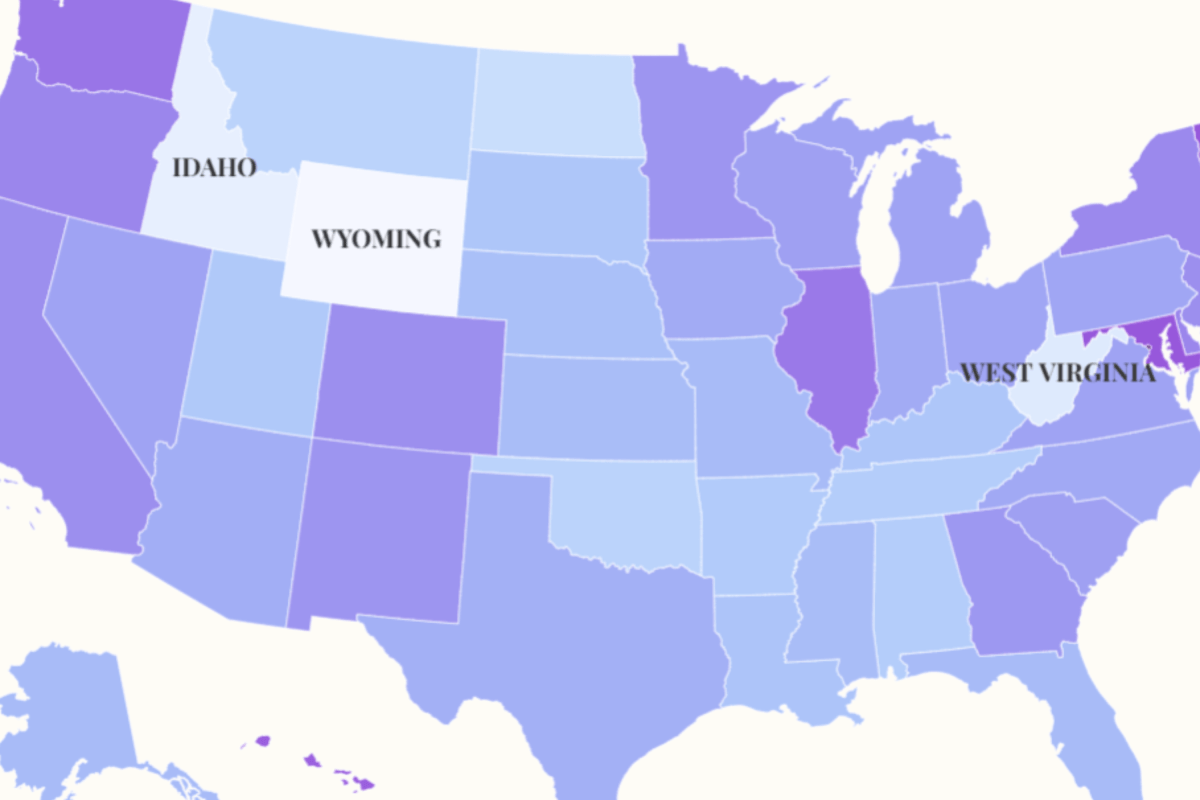
President Donald Trump’s approval rating is underwater in all but Idaho, West Virginia and Wyoming, according to new estimates. Wyoming has the highest net approval of the three (+14), followed by Idaho (+9) and West Virginia (+6), according to The Economist’s most recent projections, using polling data from YouGov. Disapproval exceeds approval in the other 47 states and the District of Columbia, which has the lowest estimated net approval (-83), followed by Vermont and Maryland (-50), Hawaii (-48), Washington (-42) and Illinois (-41), then Connecticut and Rhode Island (-40), the tracker shows.
Trump’s approval is lowest in states that voted for former Vice President Kamala Harris in 2024 and highest in reliably Republican states. Although voters who backed Trump continue to overwhelmingly approve of his performance, the estimates indicate that dissatisfaction has spread into states he carried in 2024, including the battlegrounds of Arizona (-23), Georgia (-31), Michigan (-27), Nevada (-27), Pennsylvania (-26) and Wisconsin (-28)—states that could help determine control of Congress in this year’s midterm elections. Polls have been known to underestimate Trump's popularity, with the president outperforming pre-election expectations in three presidential campaigns.
White House spokesperson Davis Ingle told Newsweek: “The ultimate poll was November 5, 2024, when nearly 80 million Americans overwhelmingly elected President Trump to deliver on his popular and commonsense agenda. No other President in history has accomplished more for the American people than President Trump, who is working tirelessly to create jobs, cool inflation, increase housing affordability, and more. The President has already made historic progress not only in America but around the world, and this is just the beginning as his agenda continues taking effect.” The figures are state-level projections produced by The Economist using polling data from YouGov, rather than separate surveys conducted in every state.
The tracker also lists FiftyPlusOne and The Economist among its sources. Net approval is calculated by subtracting the share of respondents who disapprove of Trump’s performance from the share who approve. A positive figure means approval is higher than disapproval, while a negative figure means the reverse.
Because the results are estimates derived from polling and statistical modeling, they should not be treated as exact measurements of opinion in each state. The projections can also change as new responses are collected and the tracker is updated. Trump’s standing has implications beyond his own political fortunes.
All 435 voting seats in the House are contested every two years, while about one-third of the Senate faces election, meaning the midterms will determine control of both chambers of Congress and how much freedom the president will have to pursue his agenda during the remainder of his term Midterm elections have historically presented difficulties for the president’s party, and Trump’s approval could influence whether congressional candidates seek to campaign alongside him or distance themselves from the White House. Losing the House would also give Democrats control of committees with responsibility for scrutinizing federal agencies and administration policies. The fight for control of the chamber has already extended to congressional maps.
Extract — continue reading at the source.