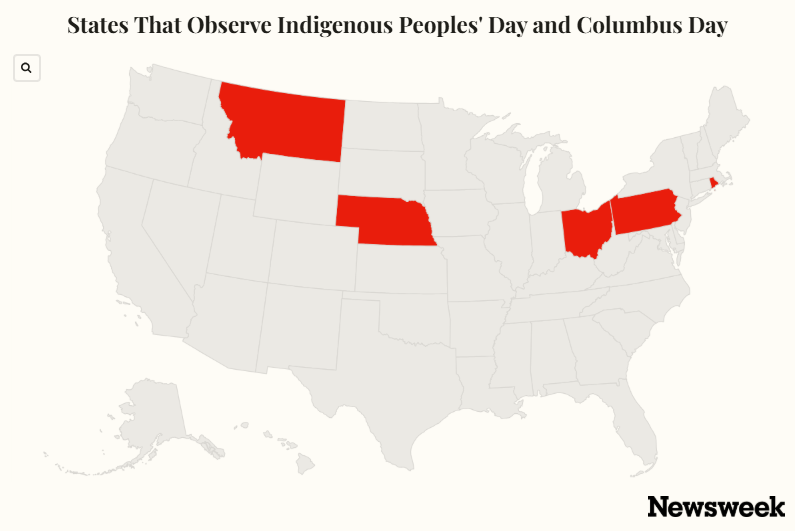
Americans mark the second Monday of October under different names depending on where they live. Across the country, states remain divided over whether to recognize Columbus Day, Indigenous Peoples' Day or both. This year, the day fell on Monday, October 12.
While Columbus Day is still one of the federal government's official holidays, states are increasingly adopting Indigenous Peoples' Day to honor Native Americans. According to Pew Research Center, 30 states and three U.S. territories recognize Columbus Day in some form, but only 20 states and two territories treat it as a paid holiday for state employees. And while 17 states and Washington, D.C., recognize Indigenous people on the second Monday in October, only five states do so alongside Columbus Day as a paid holiday: Montana, Nebraska, Ohio, Pennsylvania, and Rhode Island.
The name attached to the holiday in October has become part of a broader debate over how the United States honors its history. Columbus Day is embedded in federal law, but a growing number of states have chosen to recognize Indigenous peoples either alongside Columbus or instead of him. Indigenous Peoples' Day is not currently a federal legal holiday.
Federal law designates the second Monday of October as Columbus Day. However, President Joe Biden became the first U.S. president to issue a presidential proclamation recognizing Indigenous Peoples' Day in 2021. But that recognition did not change the statutory name of the federal holiday or replace Columbus Day.
President Donald Trump meanwhile issued a Columbus Day proclamation earlier this week, praising Columbus and declaring that his administration would defend his legacy. We cherish his memory and pledge to safeguard his story,” Trump said. But there are three different ways they are designated.
Five states have recognized an Indigenous holiday alongside Columbus Day as a paid holiday: Alabama also recognizes Columbus Day as well as American Indian Heritage Day. Four states have a paid Indigenous Peoples' holiday without simultaneously recognizing Columbus Day: Maine, New Mexico and Vermont replaced Columbus Day with Indigenous Peoples' Day in 2019, while South Dakota began observing Native American Day in 1990. Seven additional states officially recognize Indigenous people on that day without making the observance a paid state holiday: Columbus Day has disappeared from some state calendars, but it is still recognized in some states.
Extract — continue reading at the source.