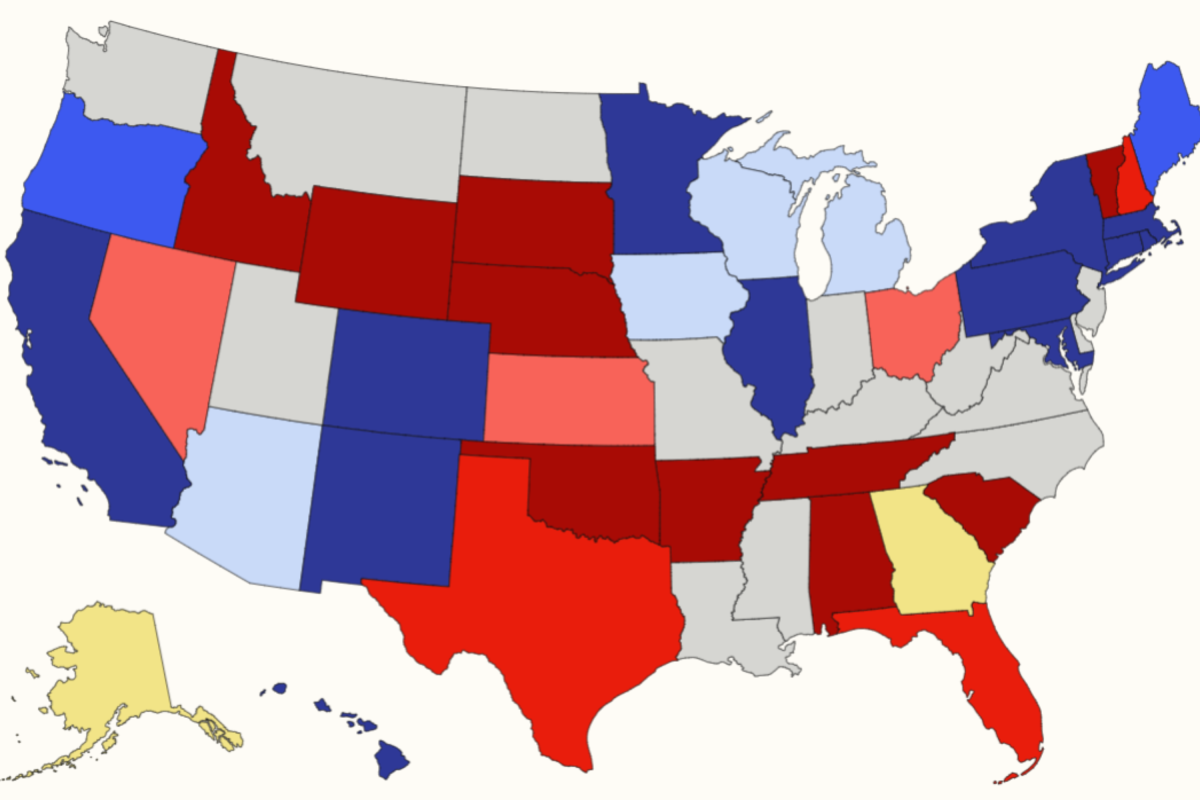
Sabato’s Crystal Ball shifted three gubernatorial ratings toward Democrats on September 3, changing its assessments in Alaska, Iowa and Pennsylvania. Republicans hold a narrow 26-24 advantage among the nation’s governors, giving Democrats a chance to draw level or take control in November. Alaska is now a Toss-Up, Iowa leans Democratic, and Pennsylvania is rated Safe Democratic, sharpening the focus on open Republican-held seats.
Republicans have controlled a majority of governorships for almost the entire period since 1994, apart from a four-year Democratic interval from early 2007 to early 2011. This year, 36 governorships are on the ballot, including 18 held by each party. Sabato’s Crystal Ball now favors Democrats in 16 races and Republicans in 18, with Alaska and Georgia unresolved.
If every race leaning toward a party follows the forecast, those two Toss-Ups will decide whether Republicans retain their advantage or Democrats gain their first majority in years. Alaska replaced Iowa as one of the forecast’s two Toss-Ups following an unusual all-party primary and subsequent candidate withdrawal. Official results show Democrat Jonathan Kreiss-Tomkins finishing first in the gubernatorial primary with 37,006 votes, or 22.52 percent.
Fellow Democrat Tom Begich placed second with 34,172 votes, followed by Republicans Bernadette Wilson with 16,468 and Dave Bronson with 13,364. Begich later withdrew and endorsed Kreiss-Tomkins, leaving one prominent Democrat against multiple Republican contenders. Crystal Ball said the configuration raised the risk of "ballot exhaustion," when voters do not rank another candidate and their ballots no longer count in subsequent rounds.
The forecaster said that uncertainty outweighed Alaska’s underlying Republican lean. Neither Kreiss-Tomkins nor the leading Republican candidates has previously demonstrated statewide electoral strength, making voter rankings and party consolidation especially important. Iowa is now the only Republican-held governorship where Crystal Ball gives Democrats the advantage.
Sand has led Lahn across several public surveys, although some margins have been narrow enough to leave room for movement. The most recent poll, conducted by Emerson College Polling and Nexstar Media from August 31 to September 1, put Sand at 49 percent and Lahn at 46 percent, with 6 percent undecided. The survey included 750 likely voters and had a margin of error of plus or minus 3.6 percentage points.
Extract — continue reading at the source.