When my first book was published, a journalist interviewing me expressed breathless surprise that I didn’t have a college degree. It would be difficult to overstate, he later wrote in the piece, how unusual this is among novelists. This was intended benevolently, but naturally carried with it the inescapable whiff of prurient patronization.
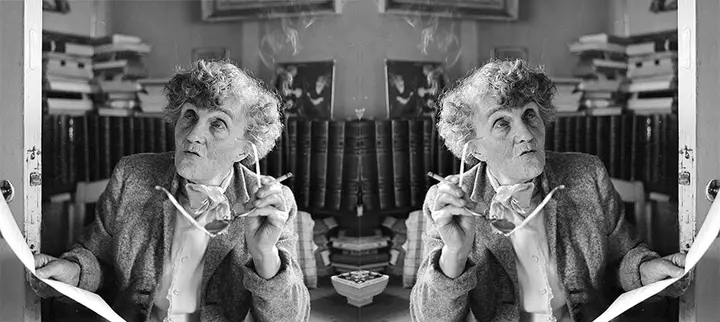
What, we might wonder, would he have made of Agnes Owens? Owens not only lacked an undergraduate degree but did poorly in school, where she was described as a hopeless case. Her first husband was a traumatized war veteran who self-medicated with alcohol, with whom she had her first four children.
After his death at the age of forty-three, she worked as a typist, in factories, and as a cleaner. She married again, had another three children, and only at the age of fifty-eight did she publish her debut story collection, Gentlemen of the West (1984). Owens was discovered at her local writing group—which she said she joined to get out of the house—by the visiting writers James Kelman, Alasdair Gray and Liz Lochhead, three pinnacles of contemporary Scottish writing.
A 2014 obituary in The Scotsman referred to her upbringing as “poor, but not uncommonly so,” a summary which recalls Kelman’s description of the life his reviewers and detractors saw as so singularly appalling and raw: “My own background is as normal or abnormal as anyone else’s.” Of her contemporaries, Kelman stands out as Owens’s particular antecedent. Owens found a novel way of conveying the surrealness of everyday life. Formally they are different, Kelman writing the Glasgow dialect more or less true to actual everyday speech, aiming to effectively trap the reader inside his narrators’ monologues.
Owens meanwhile writes staccato sentences in the vein of Gertrude Stein; simplicity which seems at times nearly aphoristic soon reveals its full effect. But they were both part of a literary era in which writers took politicized pride in the local—insistent on the validity of colloquialism in both style and substance, rooted in socialist principles rather than a more chauvinist brand of nationalism. Kelman, like Owens, refused the characterization of his work depicting life among the Scottish working class as something exhilaratingly foreign to the presumed reader.
A Working Mother (1994) was Owens’s return to publishing following a fallow period after the 1987 death of her son, Patrick, who was murdered outside the family home at the age of nineteen. Perhaps relatedly, it’s an autobiographical work, reflecting on the chaos of raising and supporting children in the midst of substance-fueled chaos. It’s a brief shock of a book, veering between the mundanity of narrator Betty’s confined domestic life and the almost slapstick moments that intrude upon it when she turns to face the outside world in search of employment.
Extract — continue reading at the source.