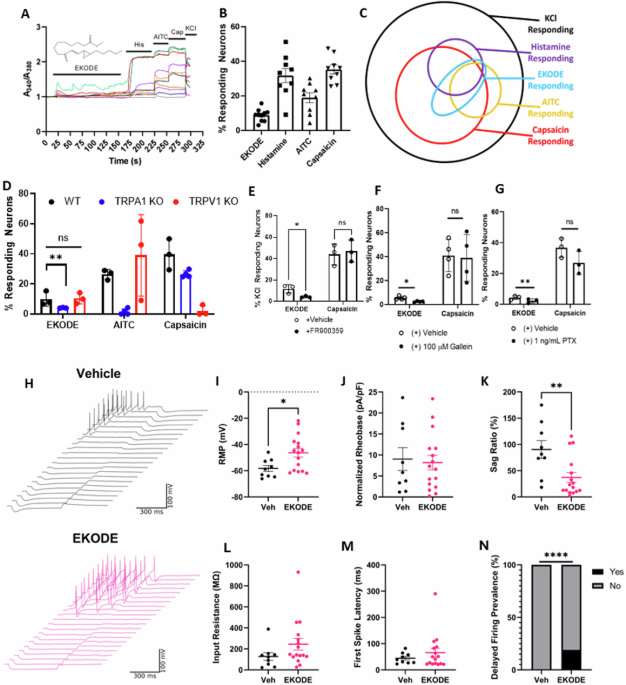
Impact of nutrition on systemic health is well-recognized but the specific sensors that couple western dietary lipid metabolites into the pathological triggers of chronic itch and inflammation remain elusive. Here, we identify a metabolic- to-sensory axis in which 9-keto-12,13-epoxy octadecenoic acid (EKODE), an endogenous dietary linoleic acid derivative acts as a potent ligand for the G protein-coupled receptor 35 (Gpr35) to drive chronic itch, inflammation, and heat hypersensitivity. We demonstrate that Gpr35 is selectively expresses in a distinct population of sensory neurons and genetic ablation of Gpr35 in sensory neurons attenuates EKODE and psoriasis-associated itch and inflammation.
Furthermore, pharmacological inhibition of Gpr35 significantly attenuates itch in mouse models of psoriasis and atopic dermatitis. We show that Gpr35 signaling engages the itch-specific brain natriuretic peptide, defining a labeled-line pathway that is functionally distinct from classical nociceptive circuits. Collectively, our findings establish Gpr35 as a critical neuro-metabolic sensor in healthy and disease conditions.
Chronic itch and inflammation are persistent and debilitating conditions that profoundly impact quality of life globally, yet the precise mechanisms driving their persistence remain a significant challenge. Itch and inflammation are interconnected and underlie several chronic diseases, from metabolic disorders to autoimmune conditions1. The severe itch associated with psoriasis is an example of inflammation-induced pruritis2,3.
Despite its prevalence, the mechanisms driving psoriasis-associated itch and inflammation remain poorly understood, and current treatments often provide only incomplete relief. The dramatic shift in modern dietary composition has been implicated in the escalating incidence of various non-communicable diseases, such as obesity, type 2 diabetes, cardiovascular disease, and certain autoimmune conditions4,5. Indeed, obese patients consuming modern industrialized diets are significantly more likely to develop psoriasis6,7,8,9,10.
While diet is widely recognized for managing chronic conditions like cardiovascular disease, diabetes, and other autoimmune disorders11, the roles dietary components and their metabolic derivatives play in chronic itch and inflammatory conditions, including psoriasis, remain largely unknown. Chronic itch signals are primarily mediated by endogenous mediators that activate receptors on primary afferent somatosensory neurons, with cell bodies located in the dorsal root ganglia (DRG)12,13. These neurons transmit itch signals to the central nervous system, often utilizing neuropeptides14.
These G-protein-coupled receptors (GPCRs) frequently activate transient receptor potential (TRP) ion channels, such as Trpv1 and Trpa1, which are key transducers of pruritic stimuli15,16,17,18,19,20,21,22,23,24,25,26. Within this context, only a small number of lipid-derived pruritogens have been identified, such as Thromboxane A2, 12-(S) HPETE, leukotriene B4, and D427,28. These aforementioned fatty acid pruritogens are metabolites of arachidonic acid (AA).
Extract — continue reading at the source.


