It was way back in the 1600s — immediately following the invention of the telescope — that moons around planets other than Earth were discovered. Jupiter’s four major moons were spotted by Galileo himself back in 1609 and 1610, leading his contemporary, Johannes Kepler, to hypothesize that the planet in between us and Jupiter — Mars — must have two moons of its own. Yet for centuries, no Martian moons were discovered.
The first moons around Saturn were found later in the 17th century, and then Uranus and many of its moons were discovered in the 18th century. Even Neptune and its giant moon, Triton, were discovered back in 1846. Only in 1877 was Kepler’s hunch confirmed: when Asaph Hall spotted Mars’s two tiny satellites for the first time.
The larger and innermore of Mars’s two moons, Phobos, is only 22.2 kilometers across, while smaller, more remote Deimos is just 12.6 kilometers wide. Both are very close to the red planet: Phobos completing an orbit every 7.66 hours at a mean distance of 9377 km from Mars’s center, and Deimos completing one every 30.35 hours at a distance of 23,460 km from the center of Mars. Although they’ve been observed remotely many times, these moons have never had an _in situ_ mission dedicated to studying them before, and despite a plethora of indirect evidence, their origins remain uncertain.
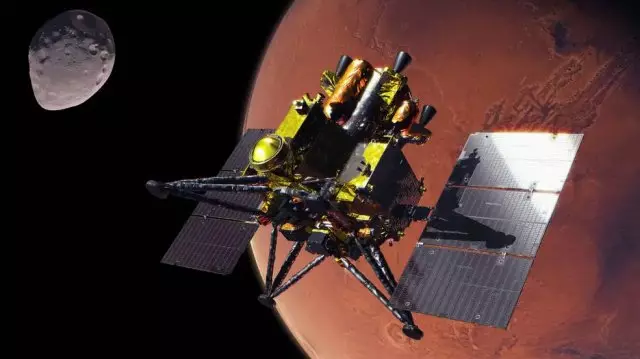
All of that is poised to change over the next few years, as JAXA’s MMX (Martian Moons eXplorer) mission now heads to Phobos and Deimos, where an orbiter, lander, rover, and sample return mission are all set to teach us more about these remote, tiny worlds than ever before. Here’s what lies in store. The relative sizes of the asteroid-like moons of Mars, Phobos and Deimos.
Phobos is the innermost moon of Mars while the smaller Deimos is more than twice as far away. Despite their appearances as looking similar to asteroids, it’s thought that Phobos and Deimos were once joined by a larger, third, inner moon, which has since decayed and fallen back to Mars. All are thought to originate from a giant, ancient impact.
It might sound like a bit of hyperbole, but when it comes to Mars, understanding its moons is the key to understanding the entire history of the red planet. There are two main scenarios for how these moons came to be, and they would both lead to entirely different planetary histories for the Mars, and determining as much as we can about which scenario occurred, and in as much detail as possible, is the whole goal of the MMX mission. The possibility that these moons formed from a primordial circumplanetary disk around Mars has also been considered, but for such a small mass planet as Mars, isn’t a particularly viable scenario.
Extract — continue reading at the source.