They are calls for help, honed by evolution to spur an immediate, ingrained response. When a human mother hears her baby crying, her brain elicits a “do-or-die” response in neuronal activity in the midbrain’s survival region. A new study published this week in Frontiers in Ethology reported that it’s not just human mothers that react physiologically to their baby’s cries; some bat mothers do too.
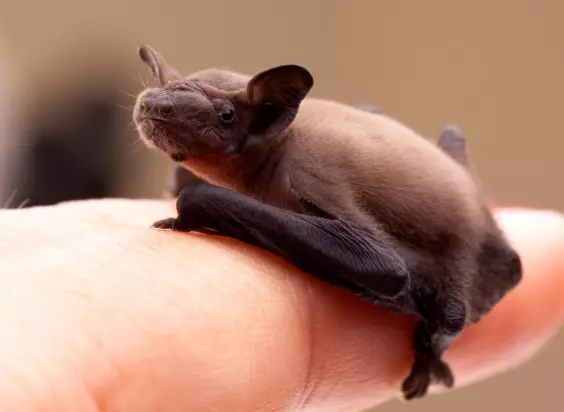
Neuroethologists from Japan studied the responses of captive Japanese house bats (Pipistrellus abramus) to their pup’s “isolation” calls—squeaky clicks that warn the mother that it’s lost or needs help. When the pups were just two days old, the researchers used ultrasonic microphones to record their isolation calls. At 30 days old, when they’d become independent and transitioned to the echolocation calls used for hunting, those were recorded too.
The two types of calls were then played back to the mothers shortly after the pups had matured. The results showed that a bat mother reacted exclusively to the recorded isolation calls of her own pups. Based on ECG recordings, her heart rate increased by as much as 70 beats per minute, showing that she was physiologically stirred by the baby’s unique sound.
Her responsiveness undoubtedly helps a Japanese house bat find her own offspring among the hundreds of bats in a colony by priming her body for action. Surprisingly, a mother’s physiological response to the echolocation calls of her mature offspring was even stronger, perhaps because she’d gotten to know the pup’s sounds better. The calls of bat pups change daily as they mature, leading the study authors to hypothesize that “mothers’ recognition abilities may undergo continuous adaptation,” as they wrote in the paper.
Unexpectedly, the study authors also detected a heart rate response of mothers to calls of unfamiliar adult males. While this shows additional complexity in bat social behavior, it was impossible to determine whether it was a positive arousal reaction or a negative reaction to a perceived threat. Regardless, mother bats’ hearts are beating to the sounds of their colony.
Subscribe to our free newsletter. Lead Image: CorinaDanielaObertas / Adobe Stock
Extract — continue reading at the source.