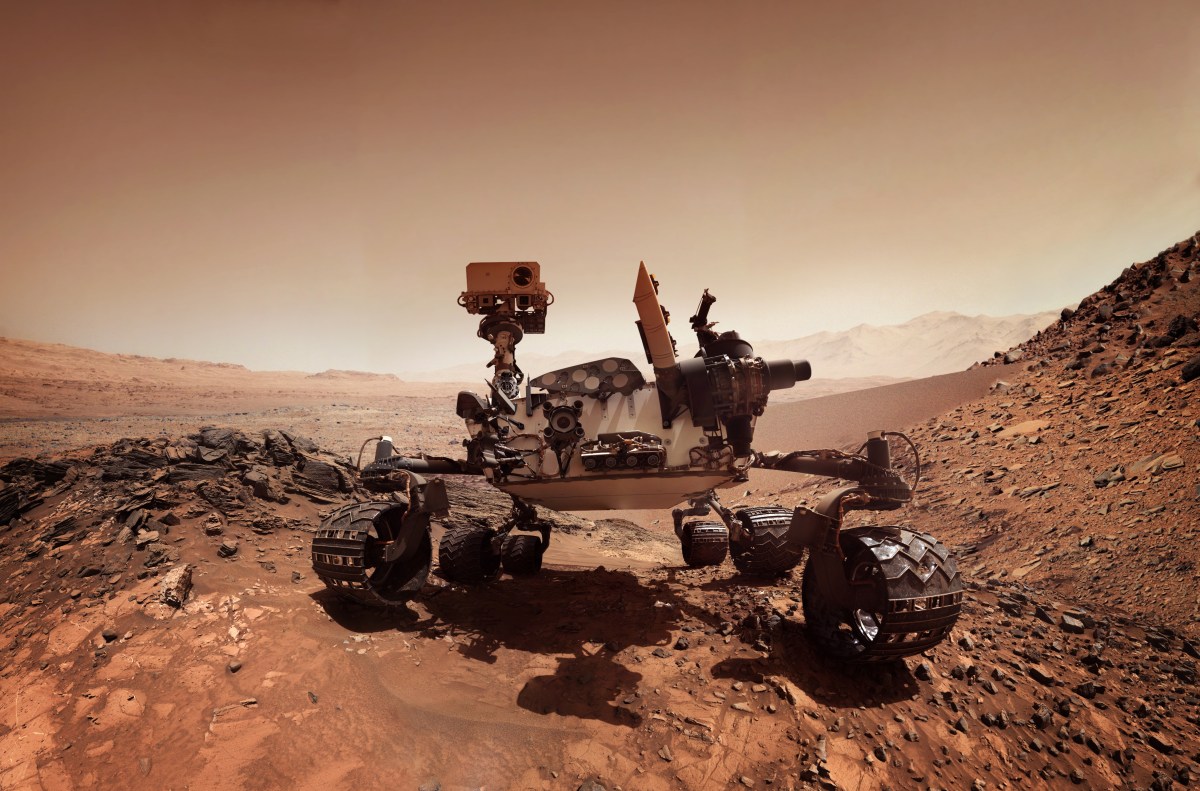
NASA may already have evidence that ancient life once existed on Mars, but retrieving that potentially transformative data millions of miles from Earth remains another question altogether. The space agency touted the July 2024 discovery by NASA's Perseverance rover in an announcement last September, extolling a sample culled from an ancient dry riverbed in the 28-mile-wide Jezero Crater as possible evidence of prior microbial life on the Red Planet. "This finding by Perseverance, launched under President Trump in his first term, is the closest we have ever come to discovering life on Mars," NASA's then-acting administrator, Sean Duffy, said at the time.
Duffy said last year that NASA remained committed to "putting American boots" on Mars, but the agency's plan to retrieve an arrow-shaped Martian rock known as Cheyava Falls was later scuttled in January as Congress enacted broad federal budget cuts. The arduous joint campaign by NASA and the European Space Agency to return Perseverance's haul, known as Mars Sample Return (MSR), is now described as a "future mission" on NASA's website, with no detailed projected dates. "Returning Mars samples would fulfill one of the highest priority solar system exploration goals from the science community," NASA's site reads.
"Returned samples would revolutionize our understanding of Mars and our solar system, and prepare for human explorers to the Red Planet." Dr. Lindsay Hays, NASA's senior scientist for Mars Exploration, participated in last year's news briefing that detailed how Perseverance discovered Cheyava Falls in 2024 while exploring the so-called Bright Angel region of Jezero Crater. The series of rocky outcrops lies on the edges of Neretva Vallis, a river channel that flowed with water more than 3.5 billion years ago.
"There was a rock that was identified by the Perseverance team in the Bright Angel Formation that had what we call textures, which is basically like features that we can see that had chemical characteristics, mineral characteristics and organic signatures," Hays told Newsweek during a recent interview. "So, all of these things together, at the resolution that we're able to get with the Perseverance rover, that look like they could have been caused by some type of microbial system basically performing a chemical reaction to basically eat material in that surface." Put plainly, Hays says evidence indicates that "something was there and ate there" while referring to the sedimentary rocks composed of clay and silt, which preserve evidence of microbial life on Earth and contain high levels of organic carbon, sulfur, oxidized iron and phosphorus, among other compounds. Analyzing the samples in terrestrial laboratories could answer whether Mars once supported life, although a definitive answer isn't guaranteed.
Researchers would, however, immediately benefit in other ways with the Martian rocks in hand, Hays said. "Return samples can also help us do things like geochronology," Hays said. "Right now when we look at Mars, we think about ages based on crater-counting and geological relationships that say this happened before that, but getting a sample back would allow us to do an absolute dating.
So, a look at some of the, you know, deeper-time dating and allow us to say this rock here is precisely this age and that allows us to sort of add dates all up and down that geological range." Securing the samples back on Earth would also give scientists a much greater understanding of dust on Mars, bits of rock or carbon-rich grains that can damage spacecraft, scientific instruments and potential habitats alike, Hays said. "Dust is a really big question if we want to think about sending people to Mars and having them stay healthy," Hays said. "The dust as we know is globally distributed." Dust found in Mars' Jezero Crater is extremely similar to fine particles from its Gale Crater, which NASA's Curiosity rover began exploring in 2012, decades after the Viking 1 lander transmitted the first image from the surface of Mars in 1976.
Extract — continue reading at the source.