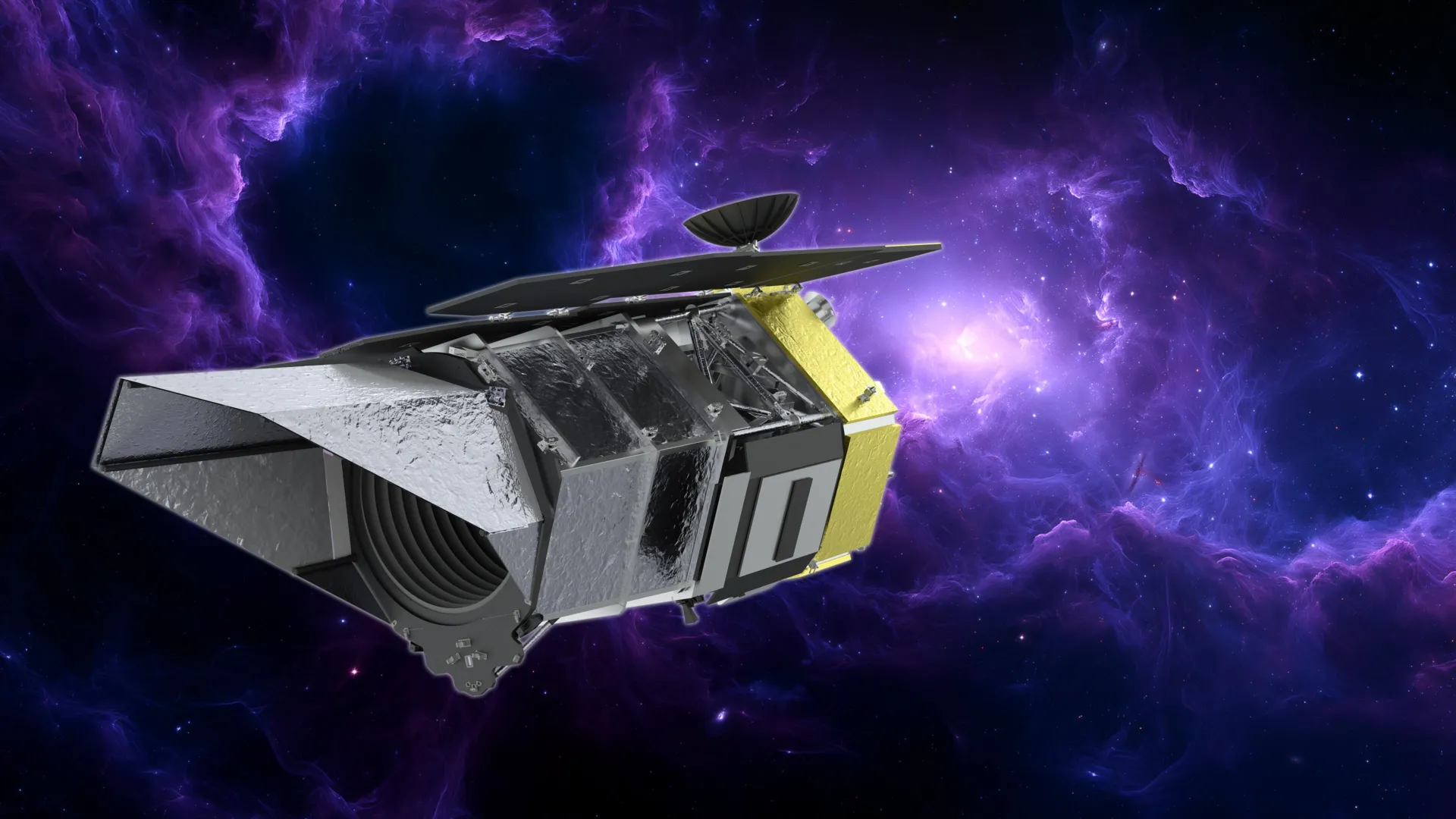
NASA's Nancy Grace Roman Space Telescope has reached another major milestone in space. Mission teams have successfully powered up the Wide Field Instrument, a 300-megapixel infrared camera designed to survey enormous areas of the universe rapidly while still capturing extremely fine detail. Roman's planet-imaging system, the Coronagraph Instrument, has also completed an early checkout of its digital, electronic, and mechanical systems after waking up earlier this month.
The tests are part of a months-long commissioning process that will continue as Roman travels roughly one million miles toward its destination at the second Lagrange point, L2. Roman's 300-Megapixel Camera Comes Online The Wide Field Instrument, or WFI, is designed to combine an unusually broad view of the sky with the kind of sharp detail associated with space telescopes such as NASA's Hubble. A single WFI image will cover an area of sky larger than the apparent size of a full moon.
That combination of wide coverage and high resolution will allow Roman to carry out enormous surveys of the cosmos. Scientists plan to use those observations to learn more about planets beyond our solar system, investigate mysteries such as dark energy, and study how matter is arranged throughout the universe. Roman's expansive and detailed observations are also expected to create a valuable dataset for many additional scientific studies.
"After years of effort to build and test the instrument on the ground, we now have confirmation that it is operational in space. This is a huge milestone for the team at Goddard, our industry teams at BAE Systems, Inc. and Teledyne, and our science centers," said Josh Schlieder, the Wide Field Instrument scientist at NASA's Goddard Space Flight Center in Greenbelt, Maryland. "There is much to do, but we are on our way to groundbreaking science." Before engineers could switch on the WFI, the instrument spent 10 days drying out and undergoing decontamination.
During that period, its detectors were kept at a relatively warm (compared to their final operating temperature) minus 85 degrees Fahrenheit, or minus 65 Celsius. On the morning of Sep. 11, the team shut off the instrument heater and allowed the WFI to cool to minus 225 degrees Fahrenheit (minus 143 degrees Celsius). At that temperature, engineers were able to activate Roman's 18 infrared detectors.
Together, those detectors have a light-sensitive area approximately the size of a laptop screen. Later that evening, the team turned on the instrument's calibration system. The following morning, engineers began sending test data through the WFI and transmitting it back to teams on Earth.
Extract — continue reading at the source.