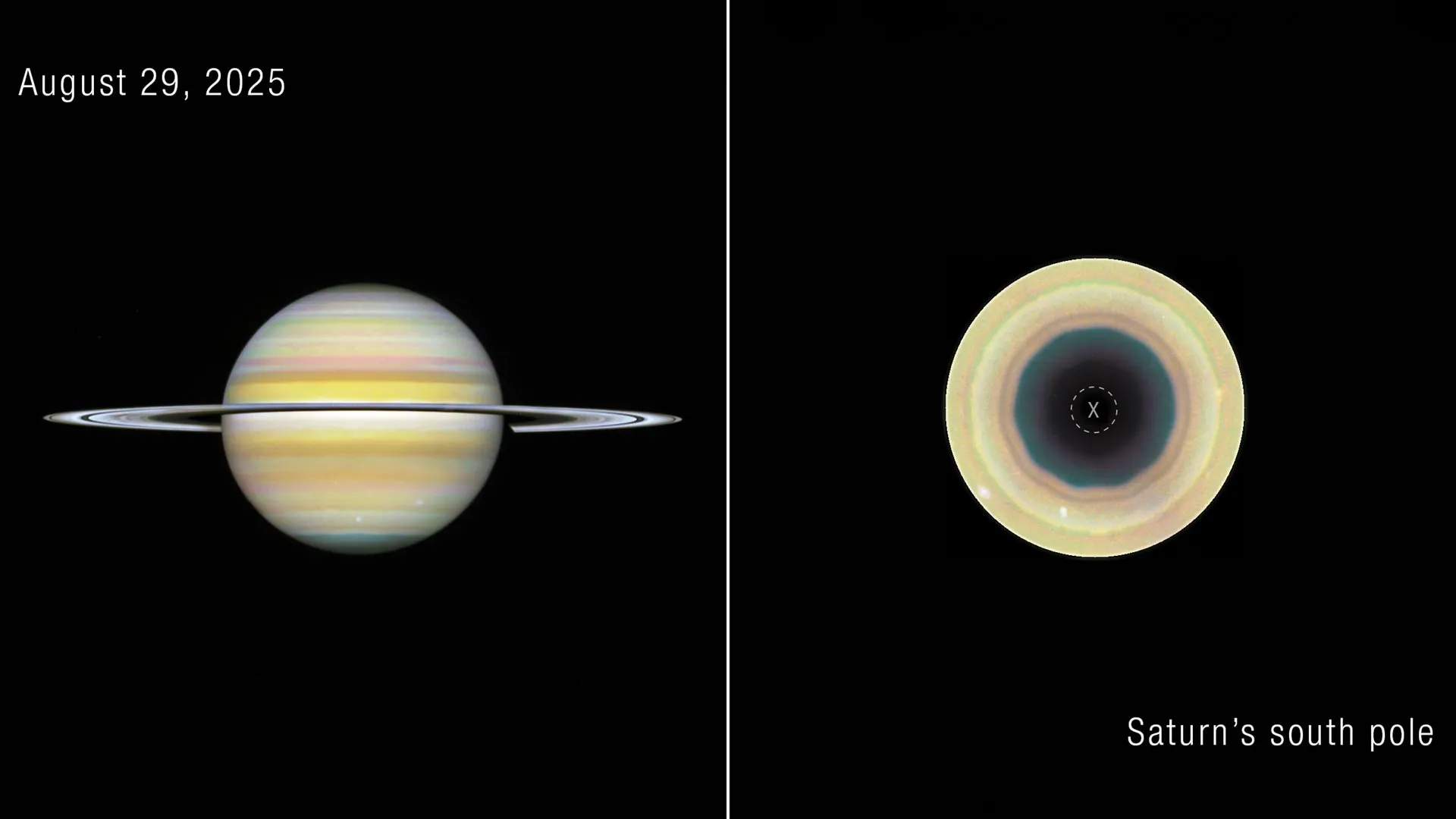
NASA's Hubble Space Telescope has spotted a striking new feature in Saturn's atmosphere: a huge, evolving 10-sided wave circling the planet's south pole. It is the first time scientists have observed a large, regularly shaped jet pattern in Saturn's southern hemisphere. The structure has some similarities to Saturn's famous hexagon at its northern pole, but important differences suggest researchers may be watching a distinct atmospheric phenomenon take shape.
The results were published in the journal Science Advances. Researchers reconstructed the development of the feature using several years of Hubble observations going back to 2023. Earlier images contained faint signs of the structure before it developed into the much clearer pattern seen more recently.
The observations came from Hubble's Outer Planet Atmospheres Legacy (OPAL) program, which has captured annual images of the outer planets for more than a decade. "We've never seen anything quite like this in Saturn's southern hemisphere," said Amy Simon, study co-author and OPAL principal investigator at NASA's Goddard Space Flight Center in Greenbelt, Maryland. "The northern hexagon has been there every time we've looked for more than 40 years.
This feature is different -- it appears to be strengthening, giving us the rare opportunity to watch a giant atmospheric pattern develop." Saturn's changing seasons played an important role in the discovery. As the planet moved through its seasonal cycle, its south pole gradually became visible again from Earth. Astronomers studying images from ground-based observatories were the first to recognize the unusual structure.
Amateur Astronomers Help Spot the Decagon Study lead author Agustín Sánchez-Lavega is a researcher at the University of the Basque Country in Spain. The university operates the Planetary Virtual Observatory Laboratory, a website that collects ground-based images of solar system planets submitted by observers around the world. In images from 2024, Sánchez-Lavega and amateur astronomers Trevor Barry and Jean-Paul Oger noticed a faint, wavy band near Saturn's south pole.
Ground-based observations collected in 2025 provided stronger evidence that the feature had developed into a decagon. Researchers then turned to Hubble for a more detailed view. Because the telescope observes from space, it can capture sharper images across complete rotations of Saturn without the blurring caused by Earth's atmosphere.
Extract — continue reading at the source.


