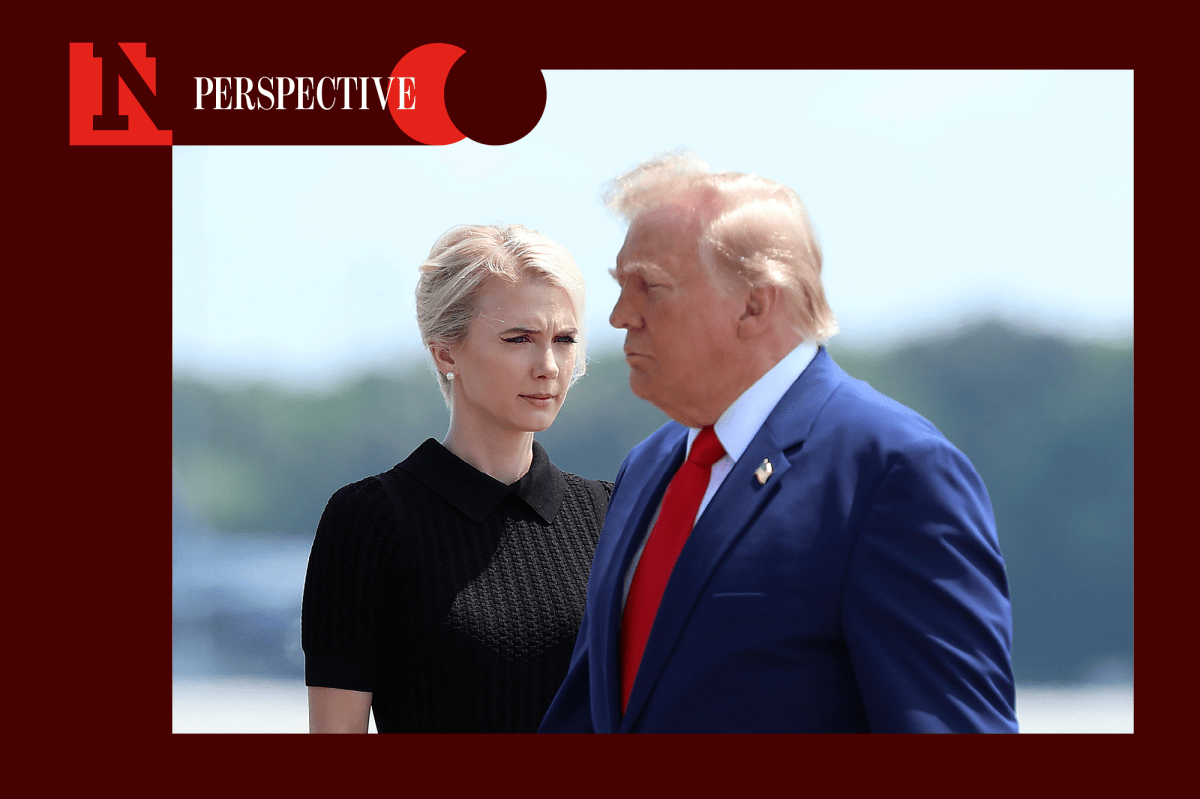
In October 2023, as Donald Trump's motorcade prepared to leave Trump Tower for a New York courthouse, Natalie Harp learned there was no seat for her. According to accounts published nearly three years later, Harp insisted Trump had personally asked her to come, argued with staff over getting into the motorcade and eventually rode in the rear cargo area of an SUV rather than stay behind. The episode remained out of public view until this week, when renewed scrutiny of Harp's unusually close relationship with Trump brought it to light.
The story is a near-perfect illustration of Harp's devotion to the president: she was willing to accept the indignity of riding in the back of an SUV simply to remain close to him. Other reported details make that devotion seem stranger still: she has reportedly written Trump letters saying, "You are all that matters to me" and calling him her "Guardian and Protector in this Life." Her Christian education, combined with her belief that Trump's Right to Try law helped save her life, gives some of that language an almost spiritual quality. It is easy, then, to treat Harp as another peculiarity of Trumpism: an exceptionally devoted follower orbiting a politician famous for demanding loyalty.
But the more revealing conclusion may be that Harp is unusual mainly in degree because American presidents have repeatedly inspired forms of loyalty that spill beyond politics into personal reverence, emotional identification and, at times, something approaching faith. Barack Obama inspired near-messianic enthusiasm among some supporters in 2008 and his once vice president Joe Biden's admiration for Obama became so central to his own political identity that the relationship often seemed to transcend the normal bond between the two roles. There’s also Woodrow Wilson's adviser Colonel Edward House, who became so personally entwined with the president that Wilson called him his "second personality." George W.
Bush's aide Karen Hughes is a good example as well, valued in part because colleagues saw her as singularly devoted to Bush himself. Harp is a more flamboyant example, sure, and perhaps a more consequential one because of how close she remains to Trump, but she belongs to a recognizable American tradition: presidents attract courtiers and believers who begin to see loyalty to the individual as something larger than service to the office. Who can forget the inspired speeches, op-eds and interviews that Obama's followers produced during the 2008 campaign?
His candidacy may have been the clearest modern example of a quasi-religious devotion attaching itself to a would-be president, with supporters investing him with hopes of redemption and national renewal that reached well beyond ordinary political enthusiasm. The phenomenon became conspicuous enough to be referred to as "Obamaphilia" and "the cult of Obama" by the media at the time. Biden carried a more intimate version of that devotion into government when he repeatedly described serving as vice president in intensely personal terms ("among the greatest honors of my life") and the friendship between their families as "a great gift." He also predicted that history would remember the Obama administration as "one of the great American presidencies." By the time Biden ran for president himself, his association with Obama had become one of the most recognizable parts of his political identity.
The "bromance" between the two men was treated partly as a joke, but it also reflected something real: Biden's public conception of his own career was deeply bound up with the president he had served. There are obvious differences between this and Harp, starting with the fact that Obama did not demand that supporters treat him as a spiritual figure. It's also obvious that Biden's affection for a colleague and friend bears little resemblance to an aide reportedly riding in the back of an SUV so as to not be separated from her boss.
Extract — continue reading at the source.