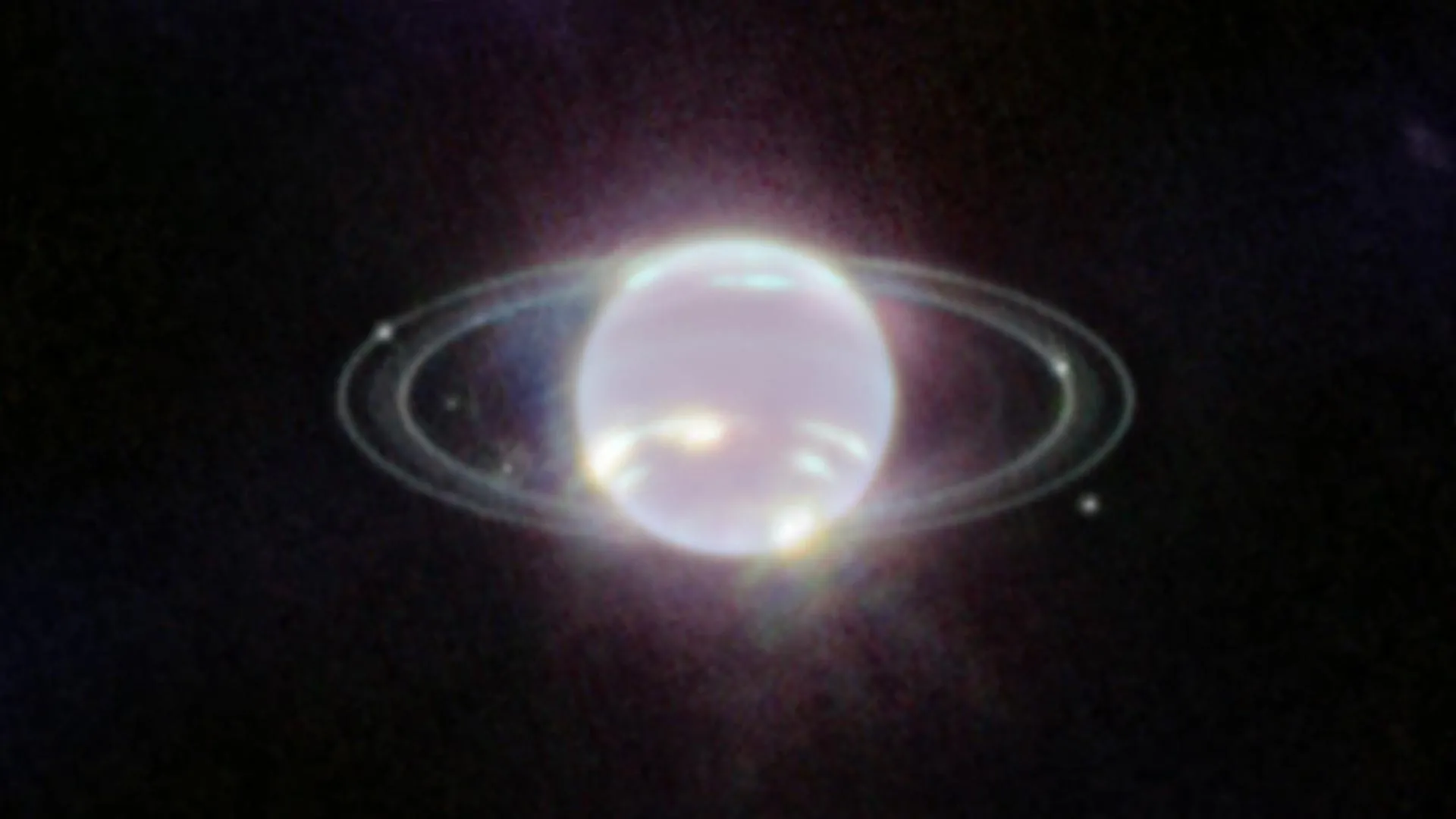
In 1989, Voyager 2 discovered six previously unknown moons around Neptune. Five of them are tiny satellites that travel just beyond the planet's main rings. Their small size and distant location have made them extremely difficult to investigate from Earth.
Now, NASA's James Webb Space Telescope (JWST) has given scientists a much closer look. A Caltech led team used Webb to study Neptune's rings along with three of its inner moons, Larissa, Galatea, and Proteus. The observations revealed a chemical makeup unlike anything previously identified among bodies in the outer solar system.
The results support the idea that Neptune once had a very different family of moons. That original satellite system may have been destroyed after Triton, Neptune's largest moon, was captured by the planet's gravity after forming elsewhere in the solar system. Researchers think some of the debris from that violent event later gathered together to create the small inner moons that orbit Neptune today.
"If Neptune once had a system of moons that looked something like what we see at Uranus today, we expect it would've been completely destroyed by the process of Triton getting captured," says former Caltech graduate student Ryleigh Davis (PhD '26), lead author of a paper about the team's findings published in Science Advances. "This is exciting new evidence that something catastrophic happened at Neptune that completely destroyed its original satellites, and we're getting to see the fingerprints left behind by that process." Neptune stands out among the planets because it does not have a "typical" system of large, orderly moons. That unusual arrangement suggests the planet's history may have unfolded very differently from the histories of other giant planets.
Another recent study from the same JWST research program, led by Caltech postdoctoral scholar Matthew Belyakov (PhD '26), offers independent support for the idea that Neptune once possessed an earlier satellite system. That research suggests Nereid may be the only moon from that original system to have survived intact. Searching for additional evidence that could help reconstruct Neptune's past, Davis, who conducted her graduate work in the lab of Mike Brown, Caltech's Richard and Barbara Rosenberg Professor of Planetary Astronomy, and her colleagues focused on the planet's inner moons.
Until recently, scientists had no spectroscopy measurements of these moons. Instruments such as JWST's near-infrared spectrograph separate incoming light into different wavelengths. Those patterns can reveal the chemical composition of distant objects and allow researchers to identify molecules and minerals on their surfaces.
Extract — continue reading at the source.