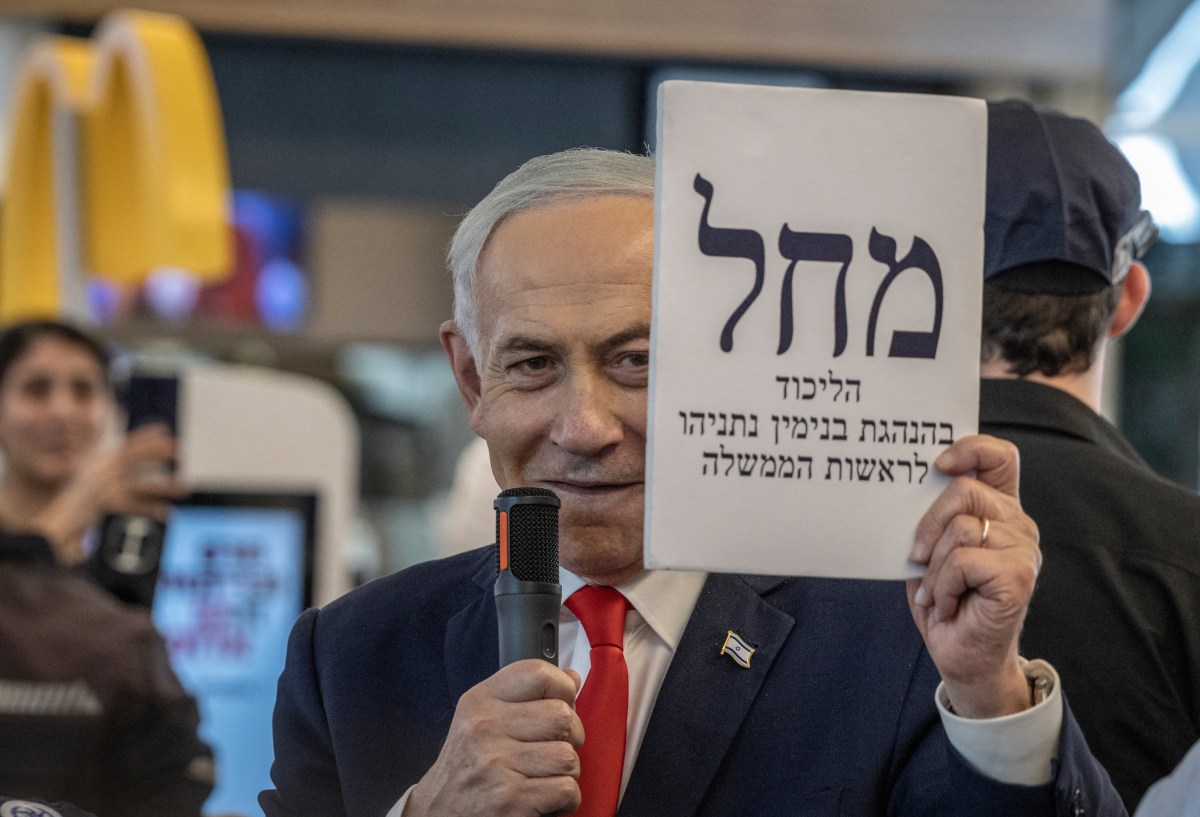
Israel's Prime Minister Benjamin Netanyahu has presented a map to outline how he views alliances across the Middle East, which a regional analyst has told Newsweek shows how isolated Israel has become under his leadership. With Israelis going to the polls on October 27, Netanyahu touted the map during his first in-person media security briefing since the Hamas attacks of October 7, 2023. It was not created by Netanyahu but originally developed by the Friedrich-Ebert-Stiftung, a think tank associated with Germany's center-left SPD party, and released in May as an analytical assessment of emerging regional alignments from Libya across to India.
"I think Netanyahu’s map is far more revealing than he probably intended," Andreas Krieg, associate professor, King’s College London (KCL) told Newsweek. "He wants to present himself as the architect of a new regional security order, but the map actually demonstrates how isolated Israel has become from the major powers in its own neighborhood," he said. Yoram Meital, professor emeritus of Middle East Studies at Ben-Gurion University of the Negev, said Netanyahu seeks to reinforce Israel's image as a powerful regional actor with strategic partnerships, influence, and continuing security challenges.
"Yet this narrative is highly selective and, in important respects, misleading," he told Newsweek. Some major Israeli media outlets boycotted last Sunday's briefing in protest at Netanyahu's limited engagement with the country's press, but it was attended by security officials and top aides, The Times of Israel reported. During the two-hour event, Netanyahu produced the map titled "geopolitical alliances in the Middle East" in which countries are shaded in colors to reflect regional alliances.
The "Israel-UAE Hexagon alliance" is in blue while in lighter blue are areas that both consider to be "friendly." These include Greece, Ethiopia and Somaliland, a partially recognized state in the Horn of Africa. Iran and its Axis of Resistance allies are shaded in purple, taking in a swathe of Yemen where a civil war is raging between the internationally recognized government and the Tehran-backed Houthis. In lavender are countries that Iran considers friendly, including Russia, and parts of Iraq.
In dark green are countries in the "Sunni Diamond Alliance" comprised of Turkey, Saudi Arabia, Egypt, and Pakistan. In a lighter shade of green are the countries that this alliance considers friendly including Sudan, Syria, and Jordan. "We changed the Middle East because we changed ourselves," Netanyahu said as he defended military campaigns against Iran and pre-emptive offensive action as necessary to contain threats following the October 7 attacks.
However, Krieg from KCL said that Netanyahu’s map "tells us less about the alliances Israel has successfully built than about the regional resistance its strategy is generating." "The more Israel seeks military hegemony, the more other states have an incentive to balance against it," he told Newsweek. "Netanyahu can redraw the map of the Middle East, but he cannot redraw the strategic interests of the countries that actually live there." "Netanyahu has essentially taken a speculative geopolitical analysis and presented it as part of his national security doctrine," he added, "a map of emerging relationships is not the same as a functioning system of alliances." Krieg said that a significant development under Netanyahu is Israel’s growing convergence with the UAE’s "axis of secessionists." "Israel is actively seeking to incorporate Abu Dhabi’s existing networks of separatist movements, armed factions and breakaway authorities into its own regional security architecture." Israel is pursuing is a revival of its old periphery doctrine, except that the new periphery is increasingly made up of substate actors rather than sovereign states, Krieg said. He believes that Netanyahu seeks to reshape the regional order by exploiting the fragmentation of neighboring states which can project influence without securing political acceptance from the region’s capitals.
Extract — continue reading at the source.