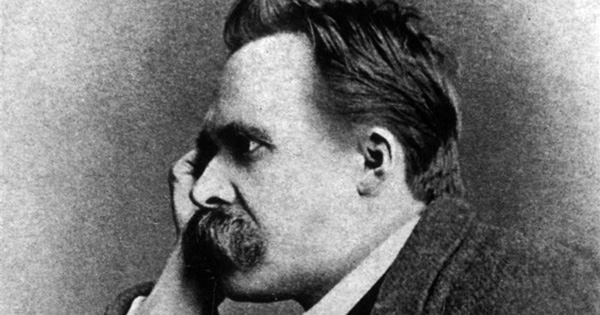
This is among life’s most abiding questions and the history of human creativity — our art and our poetry and most empathically all of our philosophy — is the history of attempts to answer it. Friedrich Nietzsche (October 15, 1844–August 25, 1900), who believed that embracing difficulty is essential for a fulfilling life, considered the journey of self-discovery one of the greatest and most fertile existential difficulties. In 1873, as he was approaching his thirtieth birthday, Nietzsche addressed this perennial question of how we find ourselves and bring forth our gifts in a beautiful essay titled Schopenhauer as Educator (public library), part of his Untimely Meditations.
Nietzsche, translated here by Daniel Pellerin, writes: Any human being who does not wish to be part of the masses need only stop making things easy for himself. Let him follow his conscience, which calls out to him: “Be yourself! All that you are now doing, thinking, desiring, all that is not you.” Every young soul hears this call by day and by night and shudders with excitement at the premonition of that degree of happiness which eternities have prepared for those who will give thought to their true liberation.
There is no way to help any soul attain this happiness, however, so long as it remains shackled with the chains of opinion and fear. And how hopeless and meaningless life can become without such a liberation! There is no drearier, sorrier creature in nature than the man who has evaded his own genius and who squints now towards the right, now towards the left, now backwards, now in any direction whatever.
Echoing Picasso’s proclamation that “to know what you’re going to draw, you have to begin drawing,” Nietzsche considers the only true antidote to this existential dreariness: No one can build you the bridge on which you, and only you, must cross the river of life. There may be countless trails and bridges and demigods who would gladly carry you across; but only at the price of pawning and forgoing yourself. There is one path in the world that none can walk but you.
But this path to finding ourselves, Nietzsche is careful to point out, is no light stroll: How can man know himself? It is a dark, mysterious business: if a hare has seven skins, a man may skin himself seventy times seven times without being able to say, “Now that is truly you; that is no longer your outside.” It is also an agonizing, hazardous undertaking thus to dig into oneself, to climb down toughly and directly into the tunnels of one’s being. How easy it is thereby to give oneself such injuries as no doctor can heal.
Moreover, why should it even be necessary given that everything bears witness to our being — our friendships and animosities, our glances and handshakes, our memories and all that we forget, our books as well as our pens. For the most important inquiry, however, there is a method. Let the young soul survey its own life with a view of the following question: “What have you truly loved thus far?
Extract — continue reading at the source.
/https://tf-cmsv2-smithsonianmag-media.s3.amazonaws.com/filer_public/b3/5d/b35d927c-99db-4447-80d5-53df2c4600cf/mit-bioreabsorb-01-press_0.jpg)