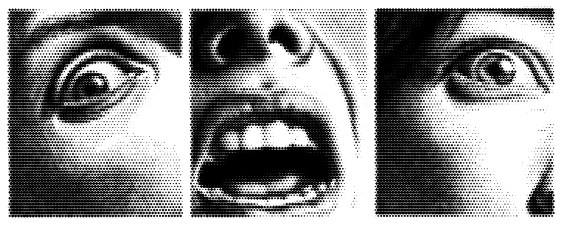
A tiger roars, a gunshot rings out, or a truck rattles around a corner too close to where we are standing, and our bodies leap into high alert, jaw clenched, hair standing on end. Often, we remain jangled long after the threat has passed, as though the tiger were still creeping around in the back of our minds. For decades, scientists have considered the amygdala, an almond-shaped cluster of brain cells near the brain stem, to be the seat of our fear responses.
But the amygdala presents a puzzle: The nerve cells in this region of the brain only fire briefly when an animal, human or otherwise, is first startled. How does the brain sustain the fear response—and prolong the fight, flight, or freeze behavior that accompanies it? Read more: “When We Were Lunch”Recently, a team of neuroscientists from the United States and China discovered a tiny brain region in male mice that sits right next to the amygdala and seems to hold the answer.
They named it the amygdalostriatal transition zone, or ASt. Neurons in this region fire with far more power and duration in response to a fear signal than neurons in the amygdala do, and the ASt communicates directly with the striatum, a brain region that plays a central role in planning, initiating and controlling voluntary movement. They published their results in Neuron.
Mice and humans have so far been found to have similar brain structures, processing, and behavioral responses when it comes to fear. So the findings may have implications for the treatment of fear and panic disorders, the researchers say. I spoke with study coauthor Kay Tye, a professor in the Systems Neurobiology Laboratory at the Salk Institute for Biological Studies, about why scientists missed this region until now, what it tells us about the fight or flight response, and how it could shake up the study of fear.
You found this region of the brain that keeps fear alive after the initial high-alert signal has come and gone. Why do you think neuroscientists had missed this until now? Honestly, I feel embarrassed that I missed it because I’ve been studying the two brain regions that lie on either side of it, the amygdala and the striatum.
We’ve always ignored this little region in between because it doesn’t have a clear boundary when you look at it under a light microscope. It doesn’t obviously look like a separate section, whereas the amygdala has dense cell clusters and fiber bundles that make it look like a different section. But when you look at the molecular identity of the cells in the ASt, you can tell that it is its own unique brain region.
Extract — continue reading at the source.
/https://tf-cmsv2-smithsonianmag-media.s3.amazonaws.com/filer_public/b6/f7/b6f771b8-a427-42f4-bde3-52aaba2da286/gettyimages-541794949.jpg)
/https://tf-cmsv2-smithsonianmag-media.s3.amazonaws.com/filer_public/50/e9/50e99089-da9f-4a3d-896e-28f2bd58ca21/aen70096-fig-0001-m.jpg)

/https://tf-cmsv2-smithsonianmag-media.s3.amazonaws.com/filer_public/b3/5d/b35d927c-99db-4447-80d5-53df2c4600cf/mit-bioreabsorb-01-press_0.jpg)