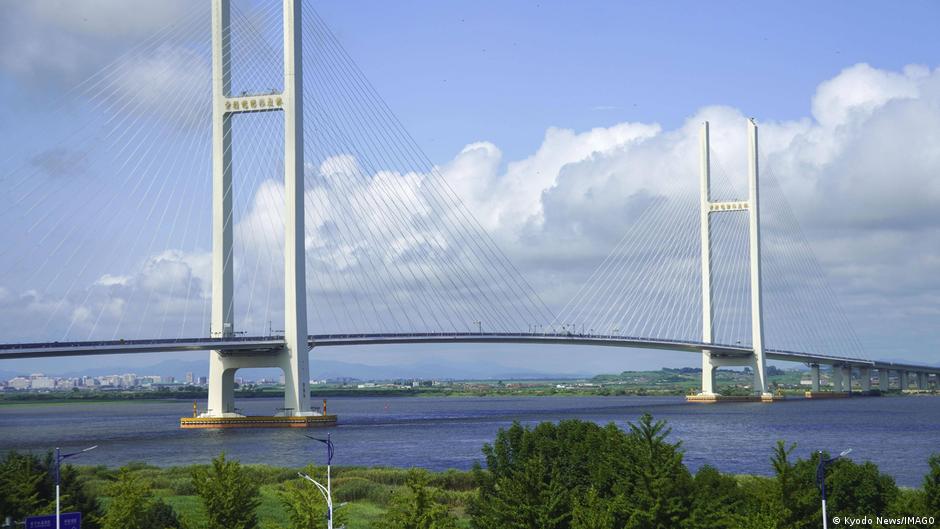
A long-delayed bridge linking North Korea and China could finally open in early October, more than a decade after its completion, as Pyongyang simultaneously expands transport links with Russia. South Korean news outlets have reported that the New Yalu River Bridge, connecting China's northeastern city of Dandong with the trade hub of Sinuiju in northwestern North Korea, could formally open by October 6, which marks the 77th anniversary of North Korea-China diplomatic relations. Analysis published by the 38 North think tank showed significant progress on customs, immigration and warehouse facilities on the North Korean side, where construction had remained largely unfinished for years.
The cable-stayed New Yalu River Bridge is located about 15 kilometers (9 miles) downstream toward the Yellow Sea from the older crossings connecting central Dandong and Sinuiju. The four-lane road bridge stretches over 3,000 meters across the river, with a network of approach roads connecting it to the surrounding areas. It was intended to ease pressure on the aging Sino-Korean Friendship Bridge, which carries both road and rail traffic and remains one of the most important routes between North Korea and China, Pyongyang's top trading partner.
The expected opening of the improved link with China comes after a road bridge crossing the Tumen River located across the peninsula was opened on September 7 connecting North Korea's Rason region with Khasan in Russia's Primorsky region. Until then, the two countries' narrow land border had been connected by rail but not by road. "North Korea allowed the Chinese bridge to sit unused for more than a decade, but North Korea hurried more than Russia did," Han Ki-bum, a former deputy director of South Korea's National Intelligence Service, told DW.
That difference, he argues, provides clues to Pyongyang's strategy, which appears to be deliberately managing the pace of its improving relations with Russia and China to avoid returning to excessive dependence on Beijing. "If it depends too much on China as it did in the past, North Korea's autonomy could be undermined," Han said, adding that Pyongyang is seeking to take advantage of good ties with both China and Russia while preserving its independence. The former Unification Ministry official added that Russia has an interest in expanding transport routes through North Korea toward the Pacific, including through the port of Rajin, while Pyongyang could benefit from increased trade, tourism and opportunities to send workers to Russia.
He added that Russia needs North Korean labor, arguing that North Korean workers are more diligent than their Russian counterparts. China, meanwhile, has its own reasons to ensure that North Korea does not become excessively reliant on Russia, the former official said. "From China's perspective, it needs to keep North Korea from leaning too far toward Russia," Han said.
Ties between Moscow and Pyongyang have grown since 2023, when North Korea began providing weapons and troops for the Ukraine war. As the Russia-North Korea strategic relationship has deepened, China has been taking steps to reassert itself as the North's primary partner. Ahn Chan-il, a former North Korean soldier who now heads the World Institute for North Korea Studies in Seoul, said the bridges have added geopolitical implications.
Extract — continue reading at the source.