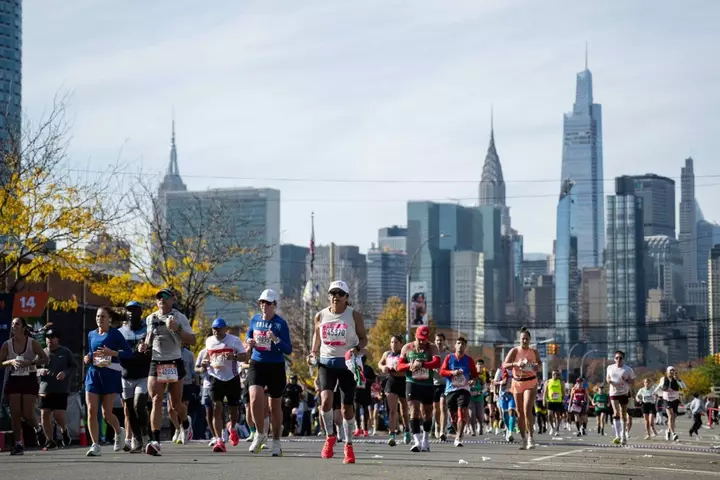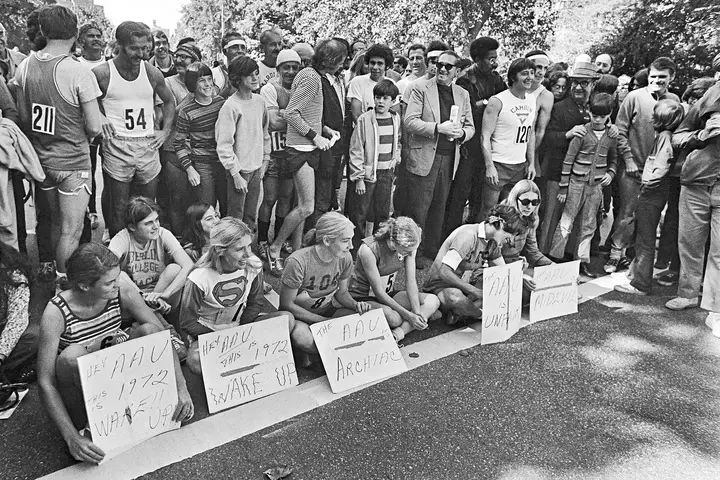
On the first Sunday morning in October 1972, Central Park was bathed in early fall sunshine, the crisp 50-degree air giving the changing leaves on the sugar maples and Sawtooth oaks near Tavern on the Green a bit of a sheen as the third New York City Marathon was scheduled to go off. It doesn’t feel right using an uppercase M with this marathon. At the time, the race was decidedly small-scale.
Only 278 runners had signed up (for this year’s race on November 4, some 47,000 have entered), they paid just $1 to get in (instead of today’s $255), and the entire 26.2-mile race took place within the confines of the park, whereas today’s marathon stretches over five boroughs and requires the space of Central Park just to stage the start. And Fred Lebow, who would ultimately become the impresario of the world’s largest race, had yet to make a name for himself beyond the city’s small and chummy running fraternity. But perhaps suggestive of his P.T.
Barnum–like skills, Lebow had persuaded The New York Times and a few other dailies to come to the park that day. News, Lebow promised, would happen. So the Times sent one of its reporters, Gerald Eskenazi, to cover the race, and Patrick Burns, a Times photographer for nearly 50 years, to shoot it.
And, as promised, something happened, without a single running step being taken. Shortly before 11 a.m., the six women entered in the race—yes, just six—lined up at the start. Lebow and his fellow organizers had openly courted women when the first New York City Marathon was held in 1970, even going so far as to ignore rules put in place by the Amateur Athletic Union that barred women from marathon race courses.
For years the AAU, the then-governing body of track and field and distance running and which sanctioned events such as marathons, had been intent on smothering a bubbling interest among women who wanted to run longer and race farther. It did so by disseminating unfounded “scientific” research (for instance, that women who ran more than a few miles risked infertility) and invoking confounding rules to keep women on the sidelines. But soon after the second New York City Marathon, in the fall of 1971, the AAU relented, somewhat, on its stance: It ruled that “certain women” could take part in marathons, provided they either start their race 10 minutes before or after the men or on a different starting line.
The rulings—imposed so women would run a “separate but equal” race from the men—were viewed by many runners of the day, female and male alike, as just the latest act of discrimination enacted by the AAU. Five of the six women on the Central Park starting line came from either Manhattan or Long Island. Their running résumés varied to the extreme: One woman had won the Boston Marathon five months earlier; another rarely ran at all.
Extract — continue reading at the source.