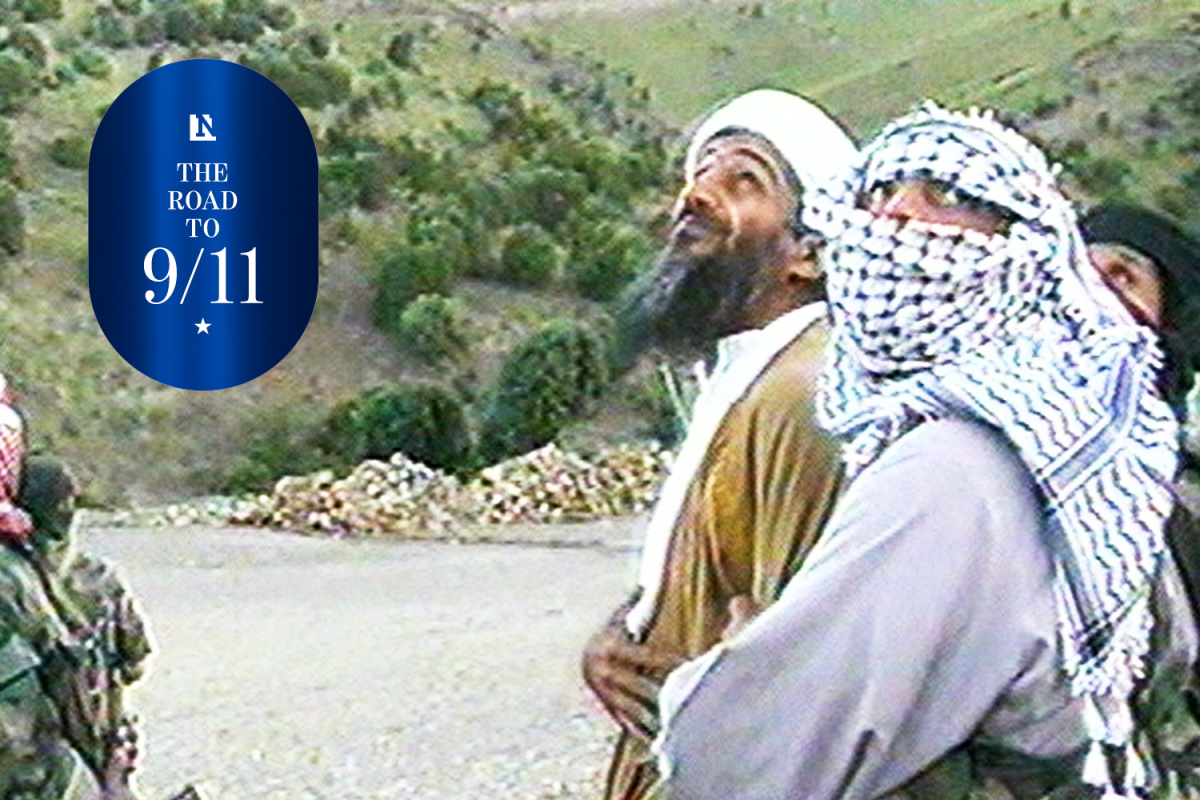
In this series, Newsweek maps the road to 9/11 as it happened 25 years ago, day by day. Yesterday: The news that Ahmad Shah Massoud had been killed "made me feel sick to my stomach," said the CIA officer who led the first team into Afghanistan after 9/11. September 10, 2001: Osama bin Laden telephoned his mother in Syria on September 10 to tell her that he might not be able to meet her for a while because "something big" was going to happen that would end their communications for a long time.
Mohammed bin Laden and his wife, Alia Ghanem, a Syrian, gave birth to Osama ("young lion" in Arabic) in Riyadh on March 10, 1957. He was the seventeenth of 52 children sired by the elder bin Laden, who over the years took 11 different wives. Bin Laden's father ended up being Saudi Arabia's wealthiest construction magnate and a close friend of the Saud royal family, granted many contracts to build basic infrastructure in the country and then to renovate Islamic holy shrines.
When he was three, Osama's mother divorced Mohammed, and bin Laden was raised by his mother's second husband in Saudi Arabia. He grew up and attended school mostly in Jeddah, joining the Muslim Brotherhood at a young age. The young Osama went to Pakistan (and then Afghanistan) after the Soviet invasion in 1979 and there became connected with a number of soaring Islamic radical intellectuals.
His main work during the Soviet occupation was caring for Afghan and Arab fighters and refugees and in monitoring Saudi and Gulf state young men who came to Afghanistan to wage "jihad." There was no contact between the CIA and bin Laden during this period, as he generally dealt with the governments of Pakistan and Saudi Arabia. With the Soviet withdrawal in 1989, the CIA also withdrew all of the support for its covert action program against the Soviets and maintained no significant assets within the country. Little was known about bin Laden other than that he was one of many financiers of radical and terrorist groups.
In 1993, a special unit was established within the CIA Counterterrorist Center (CTC) called the Bin Laden Station that focused on developing intelligence on the financier. Through 1998, when the two African embassies were attacked in August, the CIA worked alone and with friendly foreign intelligence services to disrupt bin Laden, degrade his ability to engage in terrorism, and bring him to justice. The Joint Inquiry concluded after 9/11: "Between 1996 and September 2001, the counterterrorism strategy adopted by the U.
Government did not succeed in eliminating Afghanistan as a sanctuary and training ground for Usama Bin Ladin's [sic] terrorist network. A range of instruments was used to counter al-Qa'ida [sic], with law enforcement often emerging as a leading tool because other means were deemed not to be feasible or failed to produce results. While generating numerous successful prosecutions, law enforcement efforts were not adequate by themselves to target or eliminate Bin Ladin's sanctuary.
Extract — continue reading at the source.