Human neurons are postmitotic and long-lived, requiring precise genomic regulation. Normal neuronal function is highly dosage-sensitive, with copy number variants (CNVs) and heterozygous point mutations associated with a host of neurodevelopmental and neuropsychiatric conditions1,2,3,4. Here we investigated somatic CNVs arising in single neurons to understand the dynamic processes that shape the normal neuronal genetic landscape.
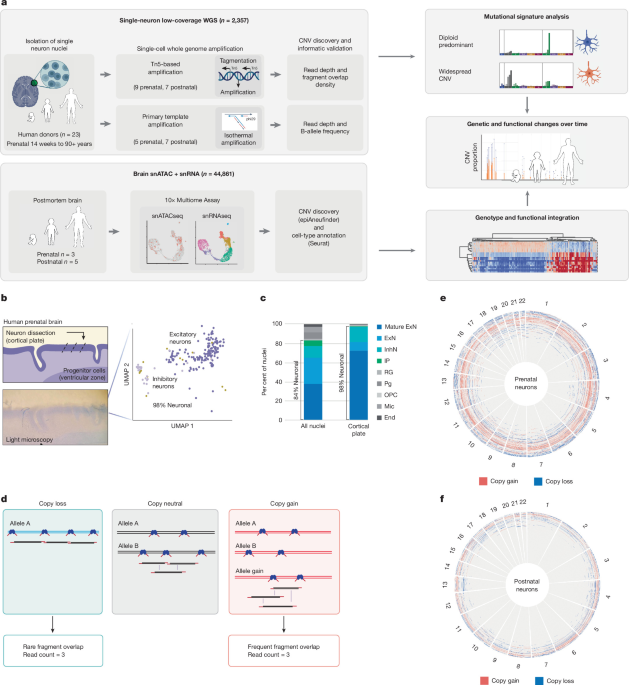
Altogether, we sequenced 2,357 single neurons from human postmortem brain from fetal to postnatal life. Two single-cell whole-genome sequencing approaches—Tn5-transposase-based amplification (1,526 neurons, 16 individuals) and primary template amplification5 (831 neurons, 12 individuals)—showed that an average of 25.9% [12.7–46%] of prenatal cortical neurons have highly aberrant genomes, that is, widespread CNVs involving multiple chromosomes. This proportion reduced by about 4.5-fold after birth across the two single-cell whole-genome sequencing approaches (Fisher meta-analysis P = 3.5 × 10⁻⁶).
Neurons with widespread CNVs were mainly eliminated perinatally, timed roughly parallel to periods of programmed cell death6, whereas neurons with smaller CNV burdens declined slowly in frequency with postnatal age. CNVs in surviving neurons were depleted for dosage-sensitive genes and genes involved in neurodevelopmental disorders (hypergeometric test P
Extract — continue reading at the source.