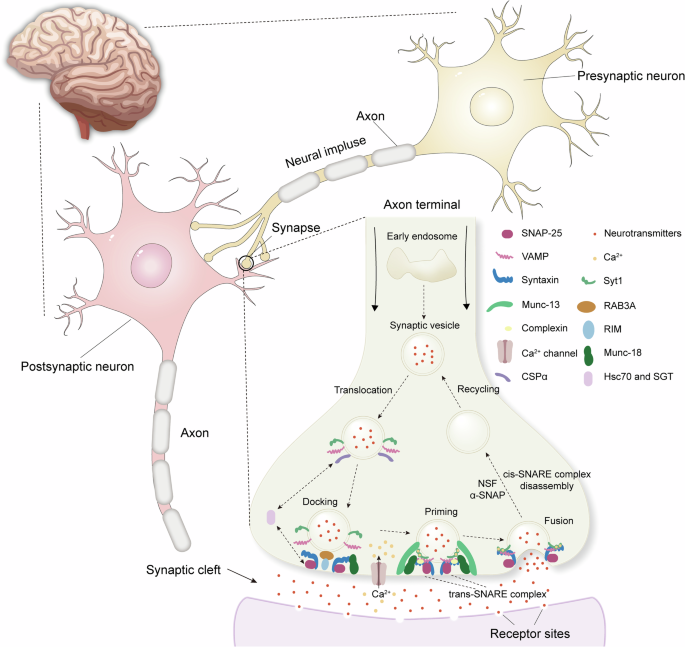
Synaptic transmission impairment and neuronal loss are hallmarks of neurodegenerative diseases (NDDs). To date, the absence of effective therapies for treating or preventing NDDs underscores the critical need to comprehend the mechanisms underlying synaptic loss and impairment to develop novel interventions. Synaptic transmission is a complex communication process between presynaptic and postsynaptic neurons.
Separate postsynaptic receptors activated by a variety of neurotransmitters initiate different downstream signaling cascades that are modulated by receptor-associated auxiliary subunits. Moreover, glia-neuron interactions and various neuropeptides can also modulate diverse synaptic functions. In this review, we first summarize the presynaptic and postsynaptic regulatory mechanisms of synaptic transmission in glutamatergic, GABAergic, cholinergic, and dopaminergic neurons in NDDs.
We then emphasize the fundamental role of microglia and astrocytes in maintaining neuronal homeostasis and discuss how glia-neuron cross-talk affects synaptic and neuronal function throughout the pathological processes of NDDs, as well as how aging accelerates synaptic dysfunction in NDDs. We also highlight therapeutic strategies aimed at preserving or restoring synaptic integrity, including approaches that enhance plasticity, fine‑tune neurotransmitter signaling, or target immune pathways. Finally, we evaluate the current state of research for each intervention class and consider the major obstacles and opportunities that lie ahead in developing effective synapse‑directed therapies for NDDs.
Synaptic transmission is a sophisticated process wherein neurotransmitters released from synaptic vesicles (SVs) of presynaptic neuronal terminals bind to and activate receptors on postsynaptic neurons, subsequently leading to the activation of postsynaptic signals. This process is tightly regulated to precision. The cognitive brain is composed of an intricate network of interconnected neurons.
During synaptic signaling, a finely tuned equilibrium between excitatory and inhibitory inputs is essential for sustaining physiological brain activity. Neurodegenerative diseases (NDDs) are characterized by the progressive loss of synapses and neurons, with functional decline escalating as the disease progresses. Currently, most NDD treatments exhibit limited efficacy, underscoring the urgent need to develop early diagnostic methods and more effective therapeutic strategies.
In this context, the accumulation of misfolded proteins is regarded as one of the predominant drivers of synaptic toxicity. Numerable research has investigated the potential causal relationships between toxic deposition of misfolded proteins and synaptic defects in NDDs, including amyloid-β (Aβ), tau, α-synuclein (α-Syn), TAR DNA-binding protein 43 (TDP-43), and mutant huntingtin (mHTT).1,2 For instance, converging evidence shows that Aβ-induced synaptic loss impairs the maintenance of normal synaptic transmission in the AD brain, thus showcasing a pivotal pathological alteration observed in AD brains.3,4 The pathogenesis of AD across different clinical stages can be attributed to impairments in various components of synaptic transmission, disrupting the delicate excitatory-inhibitory balance in neurons and even leading to irreversible neuronal damage. Despite differences in etiology, genetics, and affected brain regions, multiple major NDDs are characterized by impairments in synaptic transmission before neuronal degeneration.
Extract — continue reading at the source.