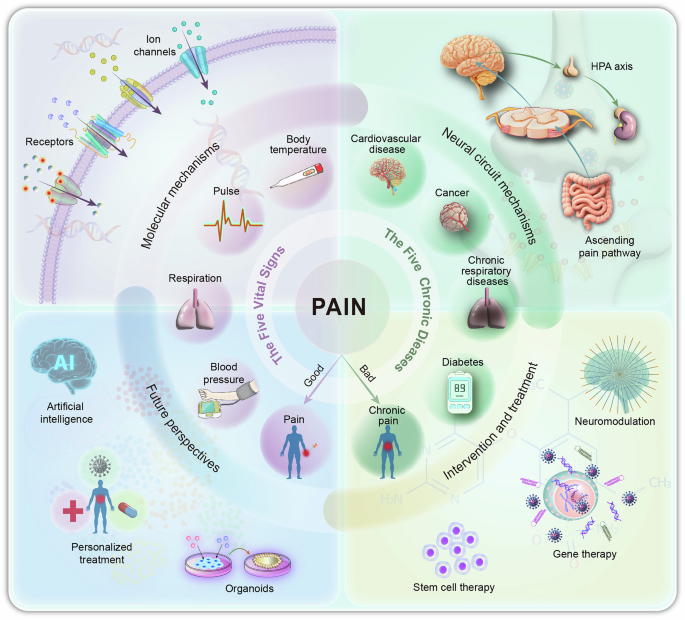
Pain is a multifaceted sensory and emotional experience that profoundly affects human health and quality of life. It functions as a double-edged sword: while acute pain serves as a protective warning signal, chronic pain compromises physiological and psychological well-being. Pain is now widely regarded as the “fifth vital sign,” and given its rising prevalence and substantial global burden, chronic pain may also be considered a major chronic disease entity.
Accordingly, elucidating the neural and molecular underpinnings of pain and developing effective analgesic strategies remain urgent priorities. This review provides a comprehensive overview of the molecular and neural circuit mechanisms that govern pain. At the molecular level, ion channels, diverse receptor systems, and intricate signaling pathways play central roles in the transduction and modulation of nociceptive signals.
At the circuit level, pain processing involves ascending pathways, descending modulatory systems, and distributed brain regions that collectively encode the sensory and affective dimensions of pain. Building on these mechanistic insights, we discuss current therapeutic strategies, including pharmacological and nonpharmacological interventions, as well as emerging approaches such as gene therapy, stem cell-based therapies and neuromodulation. Despite notable progress, several challenges remain, including the adverse effects associated with existing analgesics and an incomplete understanding of visceral pain mechanisms.
Future research should prioritize the integration of multiomics approaches, advanced neural circuit mapping technologies, and artificial intelligence to refine mechanistic insights and enable the development of more precise and effective pain management strategies. The primary objective of this review is to provide a systematic examination of the molecular and neural circuit mechanisms underlying diverse pain states, together with current therapeutic strategies, to inform more effective pain management. At the molecular level, advanced methodologies—including genomics, proteomics and gene editing—have enabled the identification of key genes and proteins that regulate pain processing.
Elucidating how these molecules function within nociceptive pathways provides critical insight into pain pathophysiology. At the circuit level, techniques such as optogenetics allow precise spatiotemporal manipulation of defined neuronal populations, enabling the dissection of their roles in pain perception and modulation. Despite these advances, pain management remains a major clinical challenge.
Conventional analgesics, particularly opioids, are effective but limited by addiction, respiratory depression, and gastrointestinal side effects, and many patients with neuropathic or visceral pain show inadequate responses to existing therapies.1,2,3 In contrast to previous pain reviews, this review highlights a cross‑level signal integration framework that connects molecular events (e.g., gene expression, post‑translational modifications) with neural circuit dynamics, avoiding isolated discussions of single levels or mechanisms. This framework enables systematic elucidation of how pain signals are transmitted and transformed from molecular switches to circuit‑level encoding, thus filling the gap left by prior reviews that lack explicit cascading links between molecular and circuit levels. Pain, as formally defined by the International Association for the Study of Pain (IASP), is “an unpleasant sensory and emotional experience associated with, or resembling that associated with, actual or potential tissue damage”.4 It is a complex biopsychosocial phenomenon extending beyond physical sensation to include emotional, cognitive, and behavioral dimensions.5,6,7 Pain perception is inherently subjective and influenced by individual experience, psychological state, and sociocultural context.8,9 Clinically, pain is regarded as the “fifth vital sign“10,11,12,13 and increasingly as “the fifth major chronic disease” due to its rising prevalence and burden14,15,16,17 (Fig. 1).
Extract — continue reading at the source.