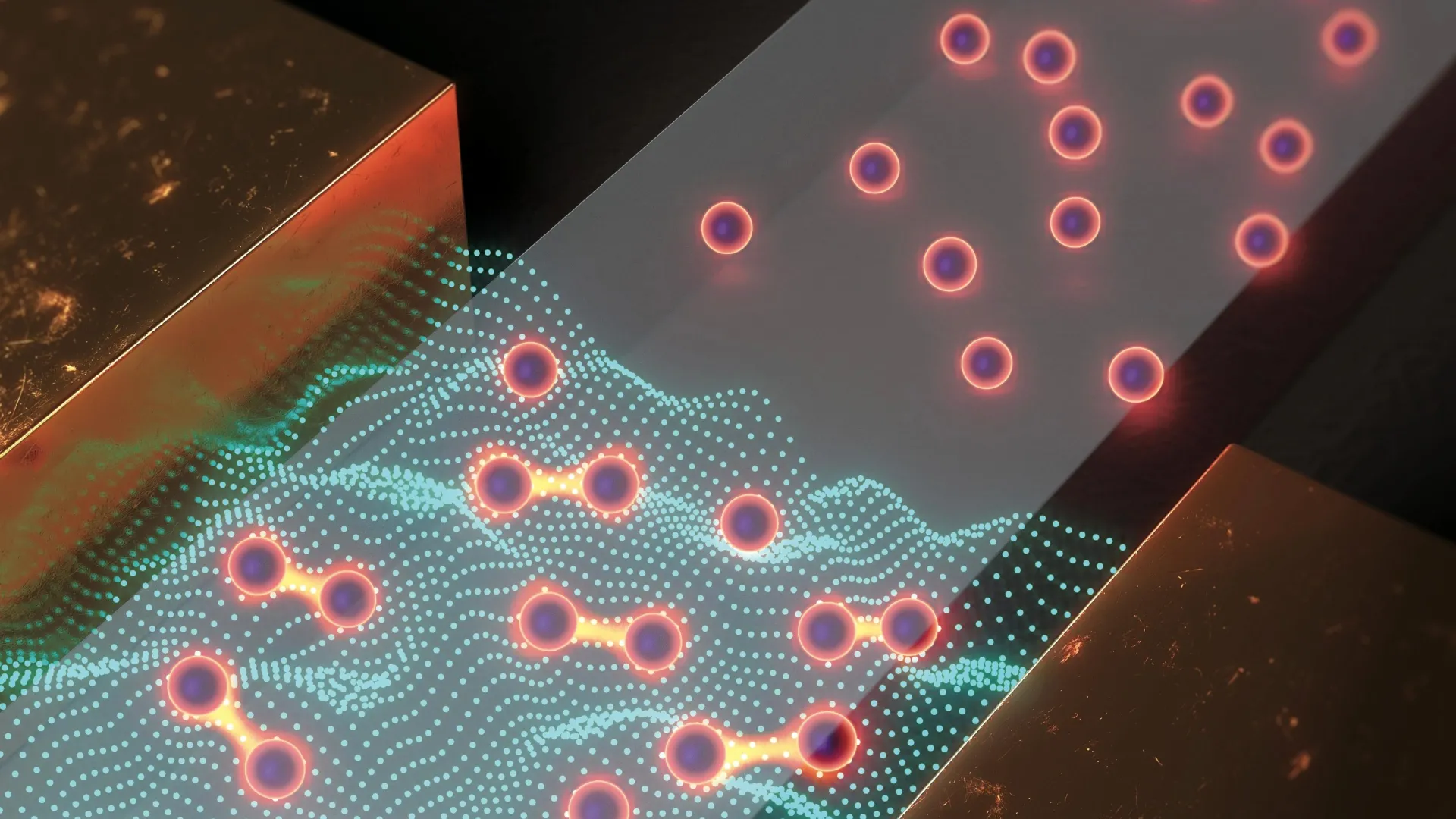
Quantum entanglement is key to solving a 250-year-old mathematical puzzle – and the discovery could ultimately help build quantum computers that are more resilient to errors. In the 1700s, according to folklore, Russian Empress Catherine the Great posed a puzzle to the polymath Leonhard Euler. Could he find a way to arrange 36 military officers from six different regiments in a 6-by-6 grid so that in each row and each column, each officer belongs to a different rank and regiment?
Euler concluded that no such arrangement exists, and more than a century later another mathematician, Gaston Tarry, rigorously proved this to be correct. After another 100 years had passed, however, the “36 officers problem” got a second life. In 2022, Karol Życzkowski at Jagiellonian University in Poland and his colleagues showed that the problem could be solved after all – if it was made quantum.
Inside the company selling quantum entanglement Now, Robin Simoens at Ghent University in Belgium and Simeon Ball at the Polytechnic University of Catalonia in Spain have built further on the 2022 work, identify the ingredient that was crucial for solving the problem: quantum entanglement. The 36 officers problem is an example of a “Latin square”, or a square grid filled with symbols that each appear once per row and column. One famous example of a Latin square is a sudoku grid.
Życzkowski and his colleagues solved their quantum Latin square by letting each officer have a quantum mixture of ranks and regiments. For example, there could be an officer for whom it would be impossible to tell with complete certainty whether he was a captain of artillery or a major of cavalry because these options would be in a quantum superposition. But their solution also contained an additional quantum ingredient.
It required all 36 officers to be connected through the inextricable link of quantum entanglement. In fact, in solving Euler’s centuries-old problem, Życzkowski and his colleagues invented a new absolutely maximally entangled (AME) quantum state. Życzkowski says that this is equivalent to entangling four six-sided dice so much that after a person rolls two dice they can predict the outcome of rolling the remaining two.
Simoens and Ball wondered how much of this quantum correlation was really necessary. He and Ball translated the problem of filling up the 6-by-6 grid into a specific type of mathematical graph. Then they used a computer algorithm to search through all iterations of this kind of graph, looking for a special feature that corresponded to a particular quantum state of the officers – one that would solve the problem through superposition alone, without requiring all that entanglement.
Extract — continue reading at the source.