This article has been reviewed according to Science X's editorial process and policies. Editors have highlighted the following attributes while ensuring the content's credibility: Among the ravenous carnivores and lumbering herbivores that roamed the Cretaceous landscape, another kind of dinosaur was evolving that started to eat something else: the plants that began to flower and produce fruit. The discovery by paleontologists from Stony Brook University, Royal Ontario Museum (ROM) and the North Dakota Geological Survey reveals that a new species, Infernogallus jamesi—a type of small oviraptorosaur—had chewing muscles for mashing soft food, making it the first known dinosaur that specifically ate fruit.
Gregory Funston, assistant professor in the Department of Anatomical Sciences at Stony Brook University, the research—which analyzed the chewing muscles of the new species, showing that it had a unique arrangement only seen in fruit-eating parrots today—was published in the journal Nature Communications. "We knew dinosaurs evolved to fill so many different roles in ecosystems in the Cretaceous, but we never expected to discover fruit-eating dinosaurs," says Funston. "For more than 100 years, we didn't know what the skulls of these animals looked like.
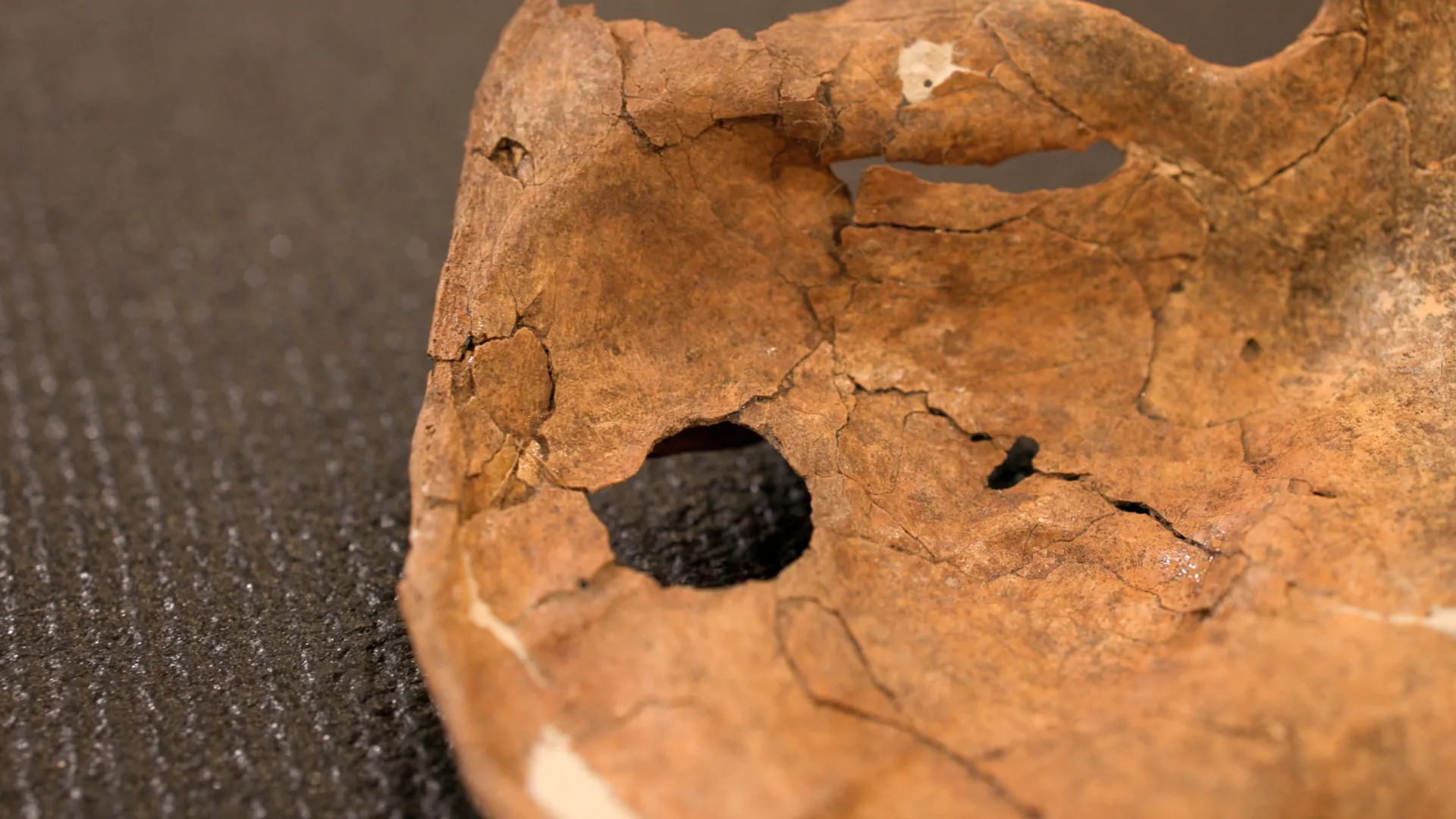
Now, we know they were even weirder than we could have predicted." Infernogallus, meaning "hell chicken," was so named because the fossils—including a nearly complete, articulated skull and partial skeleton, currently on display at the Royal Ontario Museum—were found in the Hell Creek Formation in the U.S. (stretching across Montana, North Dakota, South Dakota and Wyoming), where it would have lived alongside T. rex and Triceratops. Belonging to a group of toothless, feathered dinosaurs called caenagnathids, Infernogallus was a small dinosaur the size of a turkey and would have weighed about 12 kg (25 lbs)—making it one of the smallest members of its group even as a fully-grown adult. Curiously, Infernogallus and its relatives evolved from the meat-eating side of the dinosaur tree.
Detailed analysis of its chewing mechanics shows that its skull was specialized for mashing stone fruits to remove the flesh from the main seed. This came as a surprise, because paleontologists had previously struggled to show any clear links between dinosaur diversity and the evolution of flowering plants. However, this discovery underscores parallels between the evolutionary radiations of caenagnathids and fruit, with caenagnathids evolving their specialized chewing capabilities as fruits became bigger and more common.
"It's pretty rare for animals to become specialized for a diet of fruit, so when it happens, it comes with some remarkable adaptations," says Dr. Thomas Dudgeon, current Rebanks postdoctoral research fellow at ROM and one of the co-authors of the research paper. "The anatomy of Infernogallus is bizarre among dinosaurs, and we quickly realized that we were dealing with something special." Infernogallus's ability to chew fruit can be seen in the adaptations to its palatal bones—the parts of the skull that make up the roof of the mouth.
Using CT scans to reconstruct the skull, the researchers found that these bones arched downward into the mouth itself, which made certain muscles face front-to-back instead of up and down. This would have enabled a chewing motion where the beak slid back and forth, like in a human, instead of the rigid vertical bite of T. rex and other dinosaurs. These forward-facing muscles are rare in the animal kingdom—though they are present in mammals like humans who demonstrate complex chewing, and in some birds that specialize in fruit-eating, like the vulturine parrot (Psittrichas).
Extract — continue reading at the source.