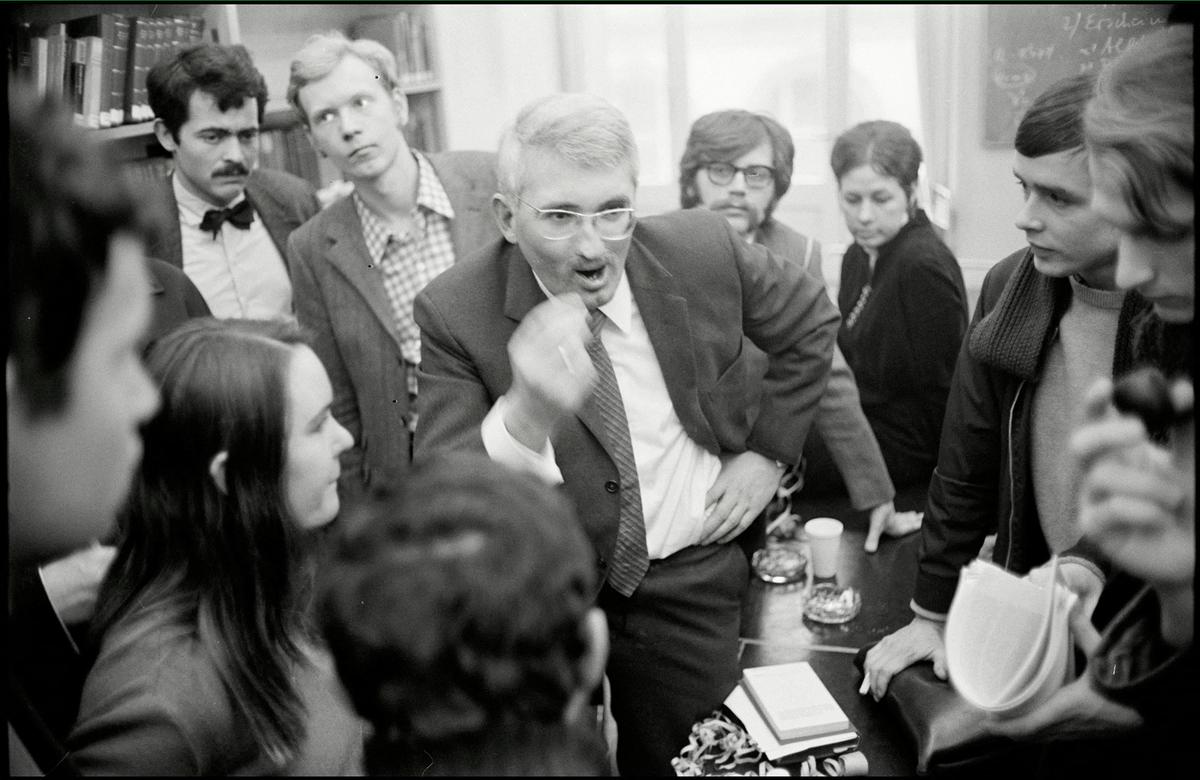
Jürgen Habermas at the philosophical faculty of Frankfurt University, Germany, in January 1969. All photos by Max Scheler/Süddeutsche Zeitung/Alamy Jürgen Habermas died on 14 March 2026, in the German town of Starnberg, aged 96. Every fall, from the mid-1990s into the late-2000s, he would come to Northwestern University in Evanston, Illinois to teach and give talks, a visit that a dedicated group of students looked forward to every fall term.
The year that has stayed with me is 2004, when he taught what he’d spelled out in Between Facts and Norms (1992), his opus applying his theory to democratic politics. Law, philosophy, history, political science: students spanned many disciplines to come watch the famous German scholar every week, dressed in Wrangler jeans and a tweed jacket, expose his theory of deliberative politics in his unmistakable nasal voice, thick German accent, and impeccable English. Max Weber and the Frankfurt School, which were intimate to him, since he’d been Theodor Adorno’s research assistant in the 1950s, came to life in his speech and then in schemas and figures in chalk as he theorised about them.
I understood almost none of it at first: words I’d read were coming to life in the room, spoken by their author, and still not resolving into sense. After several lectures, the shape came into focus: this wasn’t just Between Facts and Norms being rebuilt in public, but decades of work arriving at a single place. Since The Theory of Communicative Action (1981), Habermas had been arguing that reason survives in modern life only as something people do together, that is, by giving each other reasons and staying open to being moved by them, rather than by force, money or tradition.
Between Facts and Norms was that idea turned toward law and democracy directly: a state counts as legitimate only when its laws could in principle be justified to everyone bound by them, through exactly that kind of open exchange. I’d watched that argument take root in a decades-long intellectual history. Thinking is a practice, it involves owing each other explanations, questions, answers.
It is not a fast process, and doing it in public, out loud, in front of a room, is what makes it worthwhile. I attended all of Habermas’s seminars during my time at Northwestern with great interest and, to be honest, a sense of awe. One day, the topic of the weekly seminar was inclusion, and I had argued, with the timid conviction of a green graduate student, that deliberative publics ought to be designed for inclusion, and that entry into these publics required that members accept the terms of deliberation themselves.
After the seminars, the class would sometimes go out for drinks. It was on one of these occasions that I understood where the joke had come from. I’d asked him what it had been like arriving in the US as a visiting professor for the first time, at the New School for Social Research in the autumn of 1967, which decades earlier had served as a refuge for scholars fleeing the same Germany in which he’d grown up.
Extract — continue reading at the source.