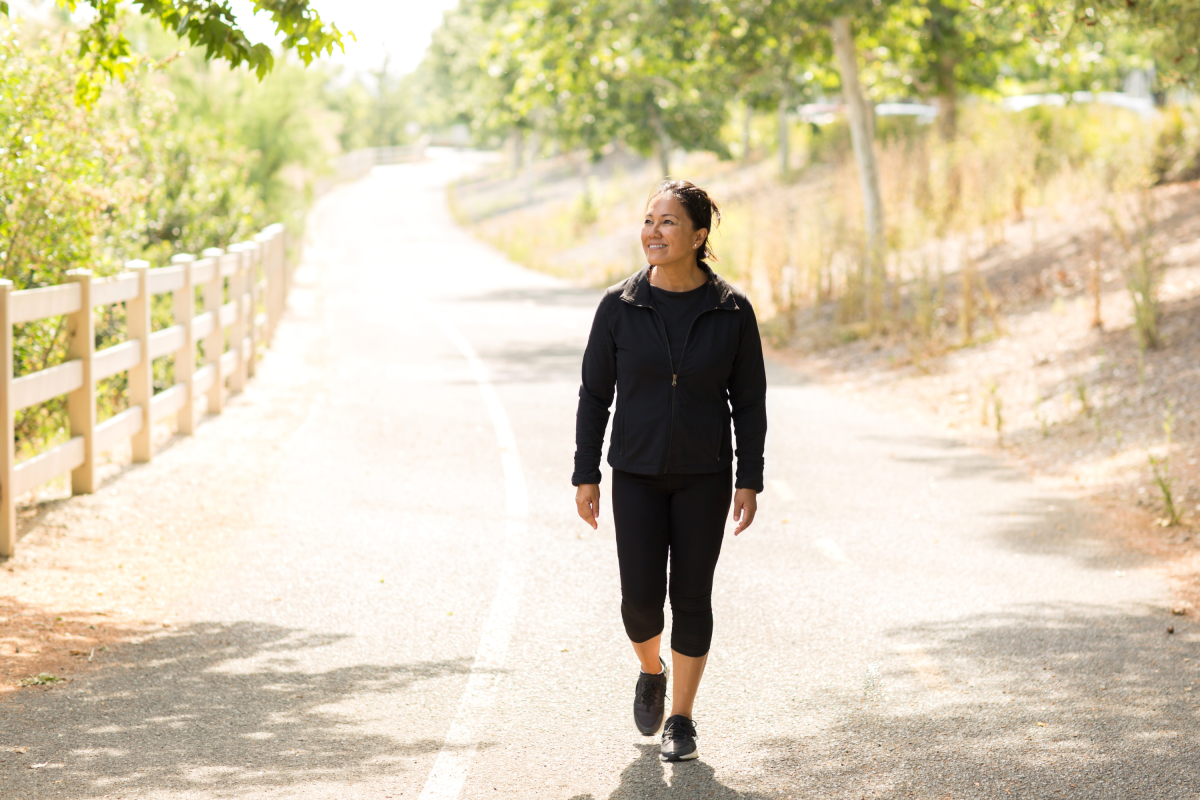
For years, health advice about walking has focused on one number: daily steps. But a new study suggests how fast you walk may be just as important as how far. Researchers analyzing data from nearly 65,000 adults with a mean age of 61.5 years at baseline found that people who walked at a brisker pace could substantially reduce their risk of early death, even if they fell short of widely promoted step-count goals.
Meanwhile, those who preferred a slower pace could still gain meaningful benefits by accumulating more steps throughout the day. "There is also no single step target for everyone," co-author Dr. Nicholas Koemel, a senior research fellow at Monash University School of Psychological Sciences, told Newsweek.
"People may have distinctly different health, occupation, and life circumstances that affect how achievable a high daily step count is." The study, published in the British Journal of Sports Medicine, tracked 64,743 adults from the U.K. Biobank who wore wrist-based activity trackers for seven days. Participants were followed for an average of about eight years, during which 1,697 participants died overall, of whom 502 died from cardiovascular disease.
The researchers examined not only how many steps participants took each day, but also their "stepping intensity," measured by cadence, or steps per minute. They then assessed how different combinations of step counts and walking pace were linked to mortality risk. The findings revealed that adults taking fewer than 5,000 daily steps, a level generally considered sedentary, still saw substantially lower mortality risks when they walked at a faster pace.
Koemel said the choice between walking farther or walking faster ultimately depends on what is most sustainable for an individual. "For those who are time poor, choosing to build habits that increase the walking pace may be good first target, while those who struggle to walk faster due to an injury, poor balance, or fitness level may find it more sustainable to target a total daily step goal," he said. In contrast, people who preferred a slower walking speed could also lower their risk by accumulating between 5,000 and 7,500 steps per day.
Researchers found the lowest risk of death overall among adults taking approximately 7,500 to 10,000 steps per day. Within that group, the optimal pace was around 100 steps per minute, roughly equivalent to a brisk walk. Among adults taking fewer than 5,000 steps a day, Koemel noted that those who walked at a faster pace during their most active half-hour had a roughly one-quarter to one-third lower risk of dying during the follow-up period than people in the same step-count category who only ever walked slowly.
Extract — continue reading at the source.