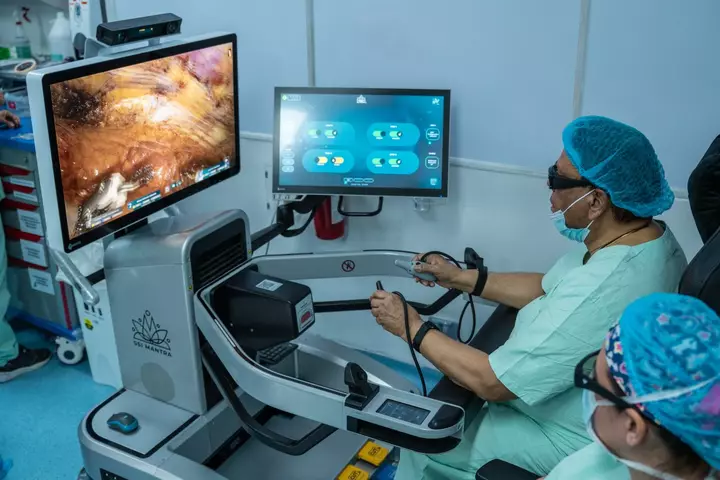
Surgery has moved steadily toward greater precision and less invasive approaches. Robotics marks another step in that evolution, extending what surgeons can do while keeping clinical judgment, experience, and responsibility at the center of every decision. At International Hospital of Colombia (HIC), our experience has reinforced a fundamental lesson: owning a robot is not the same as having a robotic surgery program.
A program requires trained teams, appropriate patient selection, clear protocols, outcome measurement and an organizational structure capable of integrating technology into everyday clinical practice. Our journey began in orthopedics, with Mako for joint replacement surgery. It then expanded to a multi-specialty platform with SSI Mantra 3 and, in 2026, reached one of the most technically demanding fields: robotic cardiovascular surgery.
Orthopedics: From Technology to a Clinical Program In 2023, HIC introduced the Mako robotic system, developed by Stryker, for total knee replacement, total hip replacement and partial knee replacement procedures. The system combines CT-based three-dimensional planning, individualized anatomical analysis and haptic technology that establishes virtual boundaries during bone preparation. This distinction matters because robotic surgery is still often misunderstood.
The robot does not operate autonomously; the surgeon remains in control throughout the procedure, from planning and clinical decision-making to execution. The technology supports that process by providing additional information, precision and tools that help translate the surgical plan more accurately into the operative field. In joint replacement surgery, variations of just a few millimeters can be significant.
Implant positioning, alignment, soft-tissue balance and bone preservation can influence joint stability, mobility, and postoperative recovery. With Mako, planning begins before the patient enters the operating room. A CT scan is used to create a three-dimensional model of the patient’s anatomy.
Based on that model, the surgeon can determine the size and position of the prosthetic components and anticipate necessary adjustments. During surgery, virtual boundaries help guide the robotic arm within the previously defined area. Incorporating Mako also required specialized training, workflow changes, operating-room team education, new protocols and time to move through the learning curve.
Extract — continue reading at the source.