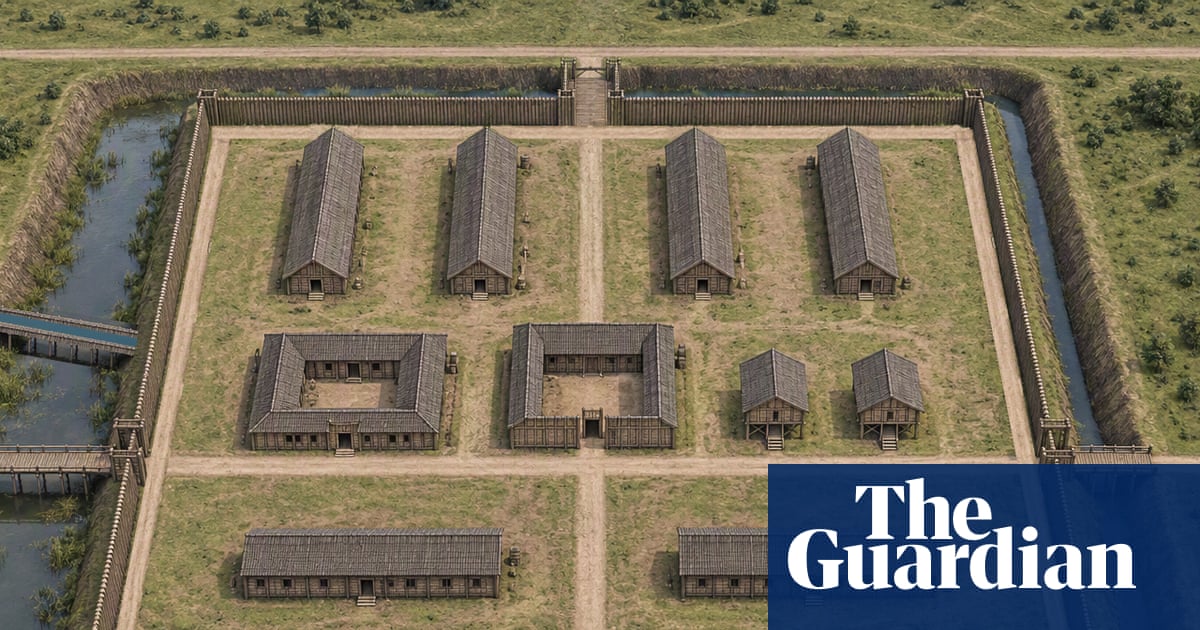
Magnus Maximus, the Roman emperor who ruled Britain in the fourth century, led his troops against the Picts and Scots, but a theory that he also established a military camp near Frenni Fawr hill in Wales has so far been based on folklore. Now fourth-century coins, among other finds at a newly identified Roman fort in Pembrokeshire, suggest the medieval tale was rooted in reality, to the excitement of archaeologists. The fort was discovered by Dr Mark Merrony, a leading Roman specialist at the University of Oxford.
He heads an excavation that is bringing to life a story about Magnus Maximus, as told in the Mabinogion, a collection of medieval epic tales of myth, magic and miracles. Merrony expressed excitement that this landscape held the only Roman military site close to where the Mabinogion places the emperor. The presence of a heavily fortified Roman auxiliary fort may help unlock the mystery of a Mabinogion legend that has endured for nearly 1,700 years.” In The Dream of Macsen Wledig, medieval storytellers used the emperor’s name in Welsh in recounting his rise to power.
They described how on his military manoeuvres, he pitched his camp at Frenni Fawr, the 395-metre (1,300ft) easternmost peak of the Preseli Hills. There had been no archaeological evidence for a Roman marching camp or fort on the summit of the Frenni Fawr or below it until now. Merrony discovered it about 2 miles (3.5km) south-west of the summit in 2024.
Satellite imagery had shown a convincing outline in an overgrown field and, shortly after visiting it, his eye was caught by a Roman tile, which turned out to be the first of many. With financial support from Oxford University and crowdfunding, one of several planned excavations has just finished, confirming his theory of the site and its significance. Merrony said that before the dig, his brother, Nick, had jokingly asked him to find a couple of coins to prove the Magnus Maximus theory.
He’d found two coins dating from the late 4th century. His previous discoveries include two Roman villas, at Ford in Pembrokeshire and at Cutteslowe in Oxfordshire. He identified a Roman road along the southern shoulder of the Preselis in 2022, challenging assumptions that the Romans did not venture far into Wales.
His research will appear in Antiqvvs, a quarterly magazine dedicated to archaeology, ancient art and history. Magnus Maximus will also feature in Merrony’s forthcoming book, titled Lives of the Roman Emperors: From Augustus to Romulus Augustulus. Measuring 180 by 150 metres, the fort is on a slope with a commanding view of the surrounding landscape.
Extract — continue reading at the source.


