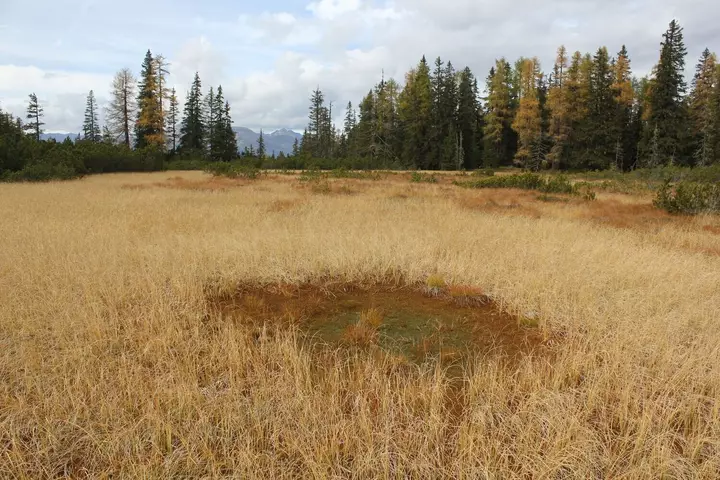
This article has been reviewed according to Science X's editorial process and policies. Editors have highlighted the following attributes while ensuring the content's credibility: Peatlands in the Alps are mostly small, scattered and difficult to access. As a result, up-to-date information on their extent and condition is often lacking.
An international research team, including researchers from the University of Göttingen, has now developed a cross-border approach to identifying these particular areas. A comparison with official maps shows that the model identifies many peatlands as smaller than previously mapped—particularly in areas where aerial photographs reveal visible signs of disturbance. The findings were published in the journal Communications Earth & Environment.
The team analyzed 590 peatlands already on maps in Austria, Germany and Switzerland. To do this, the researchers developed a new model that combines data from satellites sensing visible light as well as those that use radar, collected from 2019 to 2023, alongside data from on-the-ground studies. They then compared the results with official maps of peatlands.
It turned out that the model often indicated that these areas were significantly smaller than those shown on the official maps. The latest aerial photographs also provided clues as to possible causes. For instance, signs of disturbance were visible at almost 90% of the sites: encroaching trees and shrubs; new infrastructure or drainage for agricultural use, such as for hay production.
The drainage ditches dug for this purpose are also visible in the aerial photographs. "At first, we thought the model was wrong. But then we discovered that these 'too small' bogs were mostly located in areas that had clearly been disturbed by activity, such as new drainage ditches or paths," explains lead author Dr.
Marian Schönauer at Mendel University in the Czech Republic. Simon Drollinger at Göttingen University's Bioclimatology adds, "Alpine peatlands are small habitats of great ecological importance: they store carbon in the long term, regulate the water cycle and provide a habitat for specialized animal and plant species. Our analysis shows that the condition of many bogs in the Alpine region may be more severely affected than previously thought, and that up-to-date data are crucial for planning targeted conservation and restoration interventions." The researchers call for a more comprehensive survey of Alpine peatlands and for better coordination of their protection and restoration.
Extract — continue reading at the source.


