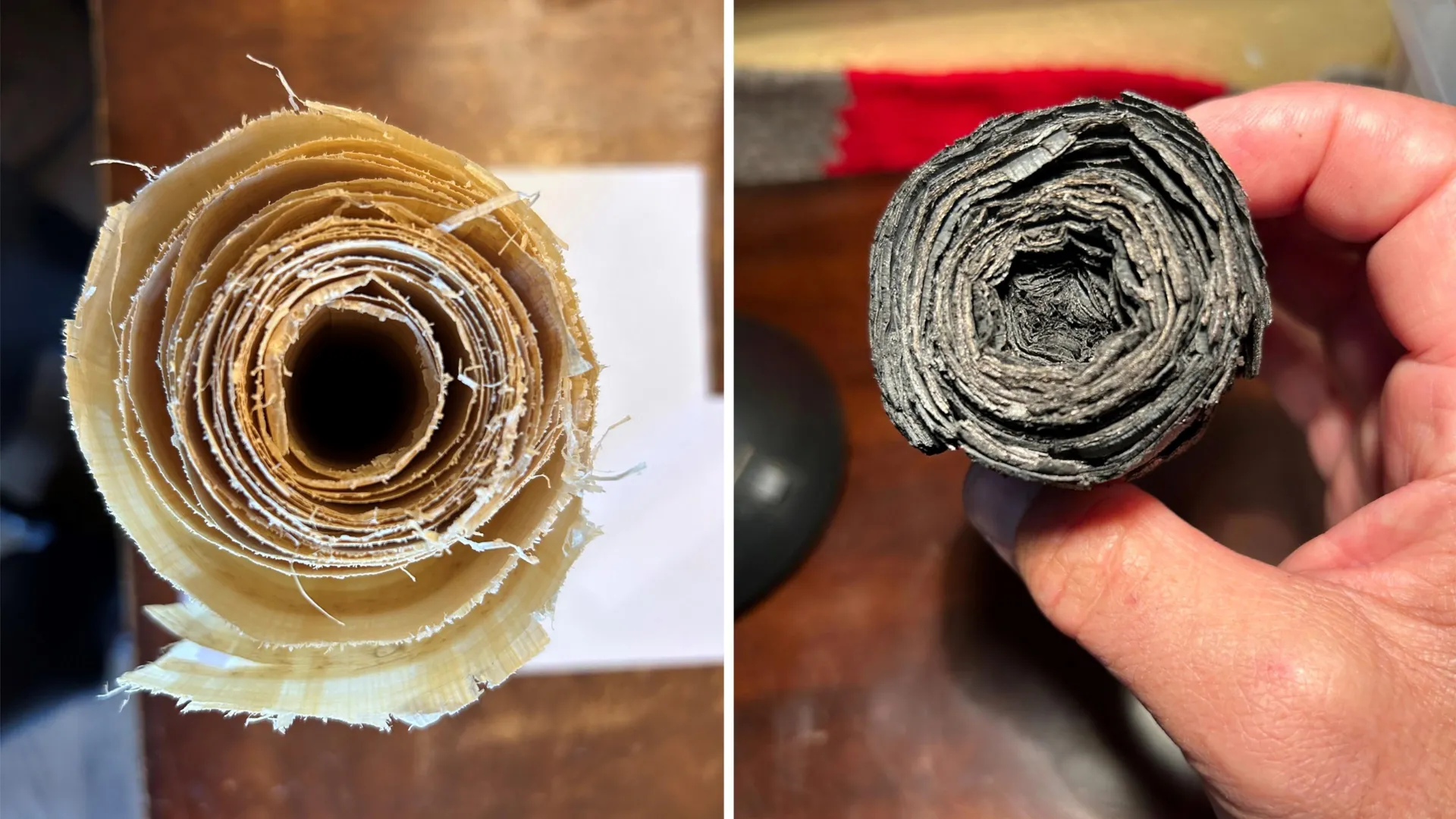
Douglas Seiler went to unusual lengths to recreate an ancient mystery. He obtained papyrus and reed pens from Egypt, along with traditional lampblack ink from Japan. Then he paid high school students to write on the papyrus using passages from "Star Wars," the Bible, and a quote from the 1960s science fiction television show "The Outer Limits." Once the writing was finished, Seiler, an affiliate of Berkeley SETI, rolled up the papyrus, sealed it inside a container, placed it in a high-temperature furnace, and burned it until it was thoroughly carbonized.
The experiment was designed to mimic a catastrophe that occurred nearly 2,000 years ago in Herculaneum, an ancient Roman city in Italy. When Mount Vesuvius erupted in 79 C.E., volcanic ash overwhelmed the city and transformed more than a thousand papyrus scrolls in a local library into fragile, charred remains. The same eruption famously buried nearby Pompeii.
Yet the destruction also produced an extraordinary form of preservation. The Herculaneum collection is the only known intact library to survive from antiquity, potentially preserving works that have otherwise vanished from history. Reading Ancient Scrolls Without Opening Them Seiler wanted to know whether researchers could recover writing from these carbonized scrolls without physically unrolling them, an action that could cause the brittle papyrus to crumble into black dust.
His idea focused on the chemistry of the ink. If some ancient inks contained lead, he reasoned, that metal might absorb X rays far more strongly than the surrounding carbonized papyrus. A computer could then use the resulting scans to virtually flatten the tightly rolled sheets and expose the hidden writing.
In a paper published on Sept. 16 in the journal PLOS ONE, Seiler and his collaborators, including several Berkeley experts, report that the strategy works in their experimental scrolls. Even extremely small amounts of lead made written characters detectable with X-ray tomography, also called X-ray CT. Lead absorbed as much as 25 times more X rays than the burned papyrus around it, causing the writing to stand out dramatically.
"With lead in the ink, you would get a huge friggin' signature, so you really need to be looking for scrolls with lead in them," Seiler said. "They're having problems reading a lot of them because of the low contrast of carbon ink on carbon paper. We're relatively certain that if they start searching for lead, or they let us search for lead, it will help this whole process.
Extract — continue reading at the source.