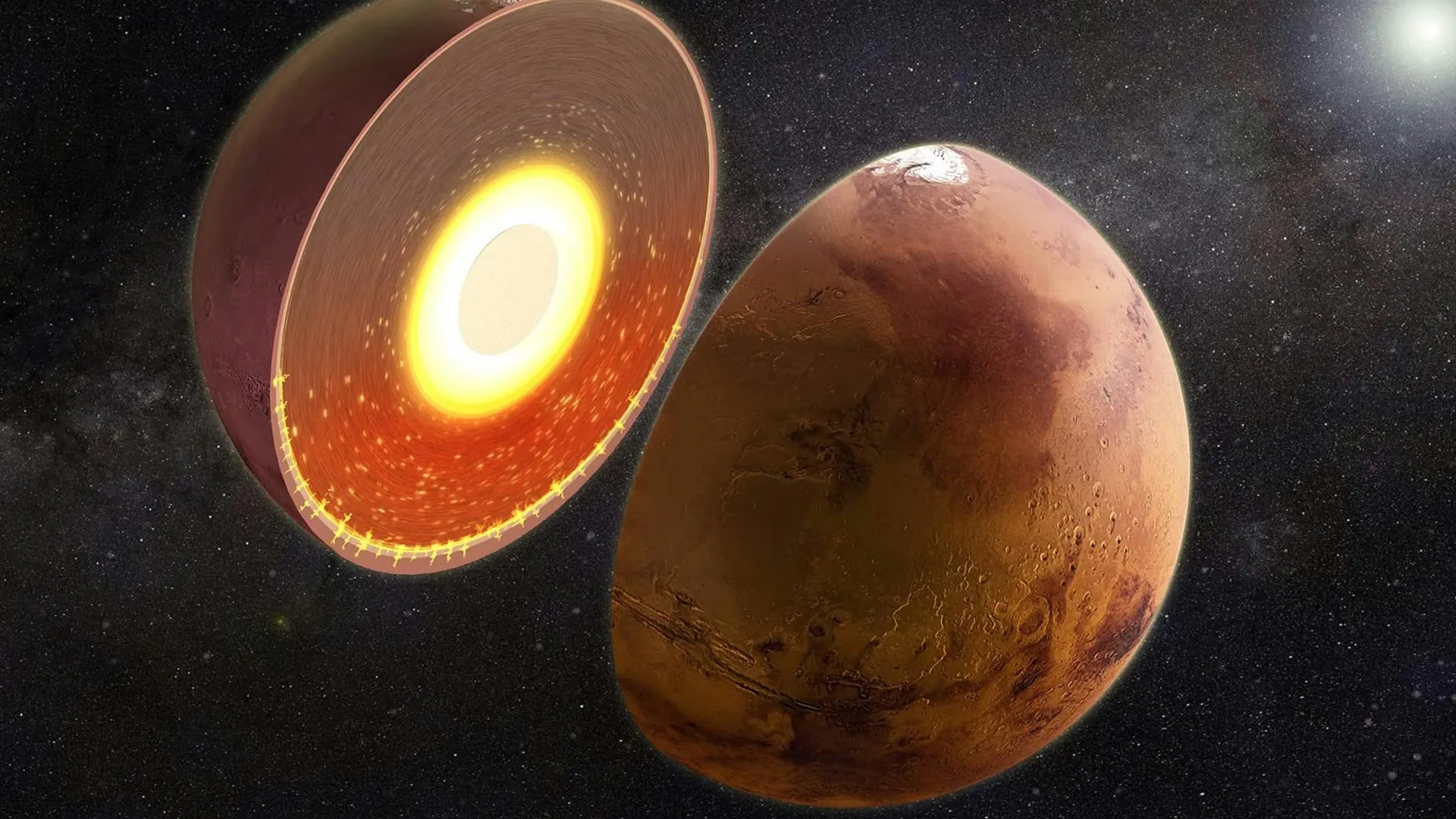
Researchers have uncovered a major temperature imbalance deep inside Mars, with the planet's southern interior appearing significantly hotter than its northern half. Gravity measurements suggest that the interior beneath Mars's southern hemisphere is about 200 to 400 degrees Celsius warmer than the north and may be partially molten. The finding offers a new window into the Red Planet's geologic history, including periods when Mars may have had environments capable of supporting life.
The study was led by Caltech alumnus Alexander Berne (PhD '26), now a postdoctoral associate at the University of Arizona. The results were published August 27 in Nature. While completing his graduate work at Caltech, Berne developed a model that uses subtle variations in gravity to estimate the internal structure of a planetary body.
He and his colleagues later applied that approach to Mars. The researchers analyzed decades of observations from three Mars missions: Mars Global Surveyor, Mars Odyssey, and Mars Reconnaissance Orbiter. By tracking extremely small changes in the spacecrafts' velocities, the team was able to reconstruct the gravitational field surrounding Mars.
The Sun's gravitational pull on Mars changes over the course of the planet's seasons because Mars travels along a slightly elliptical orbit and rotates on a tilted axis. The researchers used a method known as tidal tomography to study how these gravitational signatures change over time and to build a model of the planet's interior. "Scientists usually assume that the interiors of planetary bodies are generally spherically symmetric, but this is not necessarily true," Berne says.
"As we get more gravity data, we can determine the three-dimensional intricacies of a planet's interior structure. These inferences in turn give us a blueprint for designing future missions and scientific exploration of these worlds. Understanding the interior structure of planetary bodies helps us unravel the processes that shaped their formation and evolution." Mars has long been known to look very different across its two hemispheres.
The southern surface is dominated by tall mountains and heavily cratered terrain, while the northern hemisphere consists largely of broad, low-lying plains. The new results show that this contrast may extend far below the surface. Researchers were surprised to find that Mars is also thermally uneven inside, with the southern interior hundreds of degrees hotter than the north.
Extract — continue reading at the source.