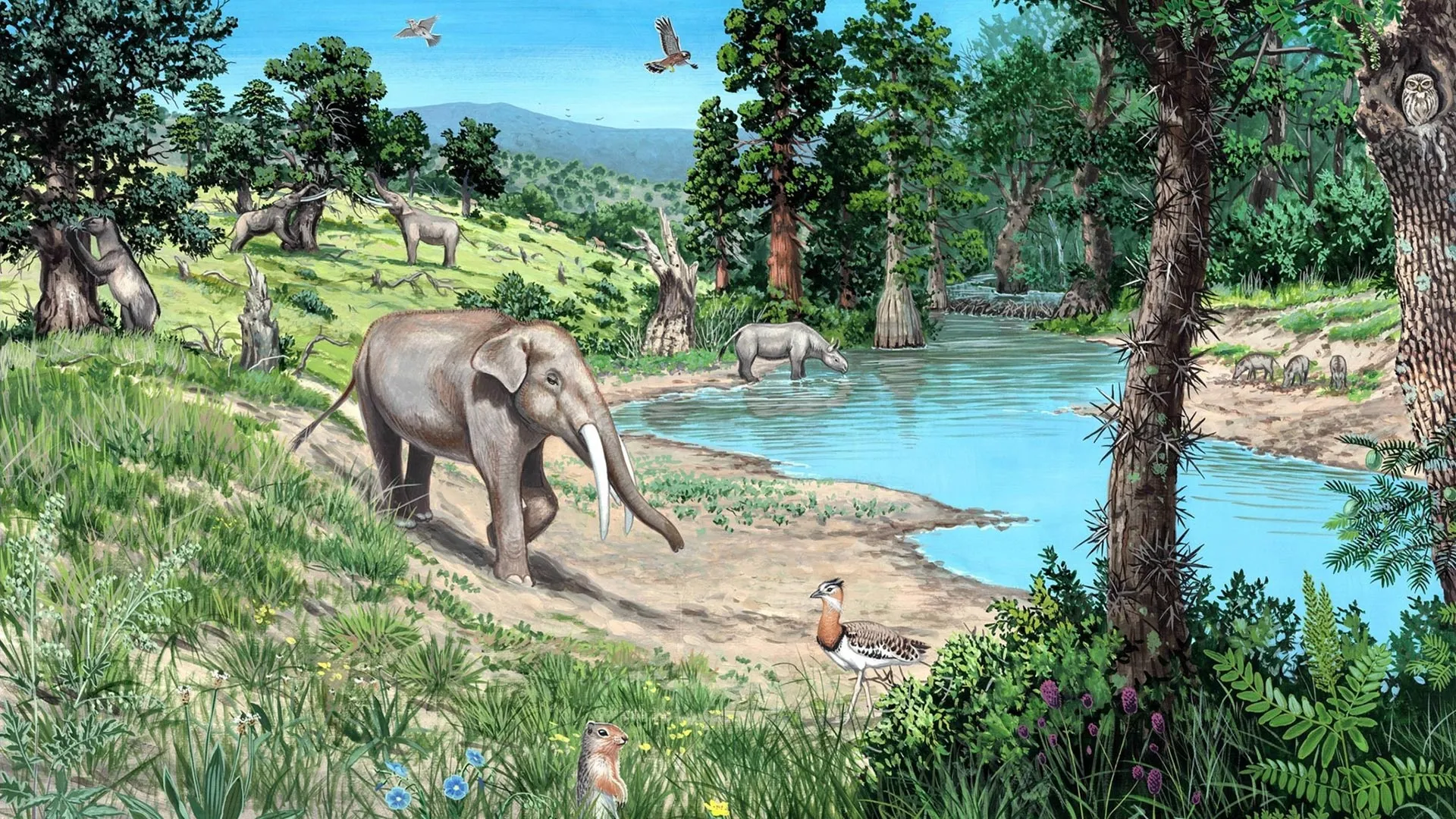
Picture the wilderness of central Europe 100,000 years ago, or even a million years ago. You might imagine an endless expanse of towering trees, with thick canopies blocking sunlight from reaching the ground. But according to a major new study, that familiar image of Europe's ancient forests is probably misleading.
Instead, much of the continent was a vibrant landscape of scattered trees, open woodlands, grassy clearings, and colorful wildflower meadows. Birds and butterflies flourished in these sunlit habitats, while enormous grazing animals helped prevent trees and shrubs from taking over. Researchers led by Aarhus University have found that this mixture of habitats dominated Europe's landscapes for more than 20 million years.
Far from being the continent's original natural condition, the dense, dark forests common in many parts of Europe today appear to be a relatively recent development in its ecological history. Published in Biological Conservation, the findings challenge a longstanding assumption about what Europe's wilderness looked like before widespread human intervention. They also raise important questions about modern reforestation programs, which often prioritize planting dense forests to combat climate change and protect biodiversity.
"The study shows that current reforestation practices are on the wrong track - both here in Denmark, where subsidies are only granted for planting dense forests, and elsewhere in Europe. This will not only be harmful for biodiversity; it will be in direct contradiction to the type of ecosystems that Europe's species have evolved in over millions of years," says Professor Jens-Christian Svenning from the Center for Ecological Dynamics in a Novel Biosphere (ECONOVO), Department of Biology at Aarhus University, senior author of the study. Challenging the Myth of Europe's Ancient Forests For decades, conservation strategies have been influenced by the "closed-forest paradigm." This is the belief that dense forests with nearly continuous tree canopies were Europe's natural landscape before humans began clearing land for agriculture and settlements.
Under this view, restoring nature often means allowing trees to reclaim open areas or planting forests where they no longer exist. The new research suggests that this approach may overlook a crucial part of Europe's ecological history. Rather than being uniformly covered by dense forests, the continent was characterized by changing combinations of grasslands, shrubs, and woodlands with different amounts of tree cover.
These landscapes supported a rich variety of species adapted to both wooded and open environments. Large plant-eating animals also played a major role in maintaining this diversity by grazing, browsing, and disturbing vegetation. What 23 Million Years of Evidence Reveals To reconstruct Europe's ancient environments, the researchers examined an unusually extensive collection of evidence spanning millions of years.
Extract — continue reading at the source.