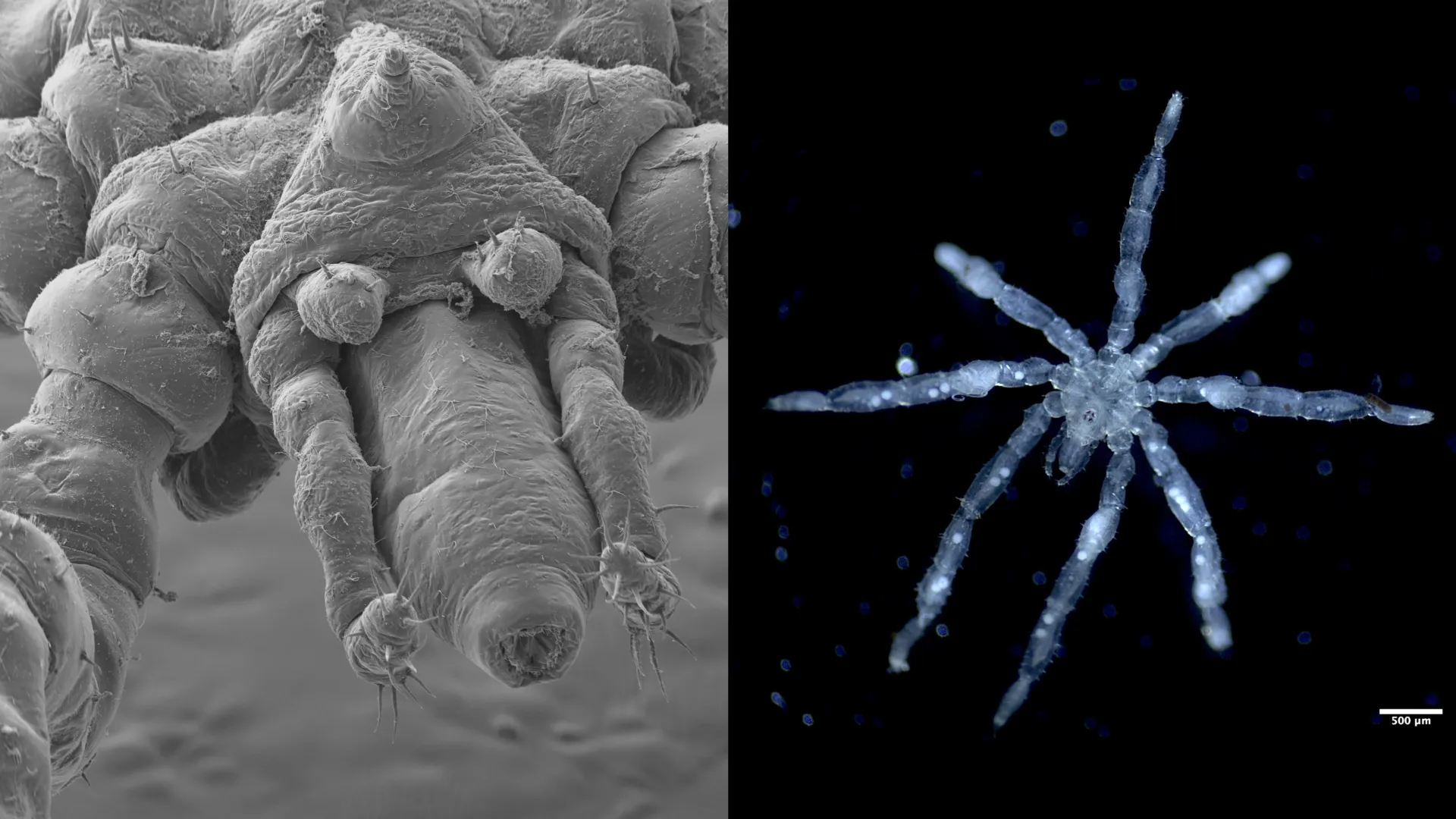
If you happen to be swimming in the Salish Sea at night and imagine tiny hairy legs creeping up your body, there is now at least one unsettling reason that image feels plausible. Researchers at the University of British Columbia have identified two previously unknown species of sea spider, including one with hairy legs and striking red eyes. The discoveries mark the first new sea spider species formally described from the Salish Sea in nearly 100 years.
Published in Organisms Diversity & Evolution, the study combines detailed physical observations with genetic analysis to help fill major gaps in scientists' understanding of these unusual marine animals. "I was interested in how sea spiders are impacted by climate change and human disturbance, because marine invertebrates in the Salish Sea are particularly at-risk, and I couldn't find anything," said lead author Cormac Toler-Scott, who conducted the work as part of his master's degree in zoology at UBC. "That's largely because people don't know much about what species exist here and what their lifestyle is." According to Toler-Scott, that lack of basic information affects many marine arthropods.
"In order to understand how marine invertebrates are being impacted by things like climate change and how we can better protect these key elements of the ecosystem, we have to be able to identify them." Sea spiders belong to an ancient lineage that arose roughly 500 million years ago. They are related to spiders, scorpions, and horseshoe crabs, but unlike their land-dwelling relatives, they remained entirely marine. Their appearance is strange even by arthropod standards.
Some species can have as many as 12 legs, along with a sucking proboscis used for feeding. Their size varies dramatically, from less than a centimeter long to more than 70 cm in Antarctica, where some species hunt smaller animals in deep ocean environments. "They've retained some weird traits," said Toler-Scott.
"A lot of the shallow water species are quite small, and so they'll live as parasites on larger organisms, and they use this weird apparatus called a proboscis to suck the juices out of their host." Sea spiders also have several unusual reproductive and physiological traits. They breathe directly through their skin, and males take responsibility for carrying and raising the young. Females have ovaries that extend through their limbs, where eggs develop before 'popping out' through a dedicated pore.
During mating, the male collects the eggs using specialized appendages near the base of his head called 'ovigers'. He coats the eggs with glue secreted from his legs and attaches clusters of egg sacs to his own body while they develop. Hairy Feet, Red Eyes, and a Strange Mouth Researchers collected the newly described species between September 2023 and August 2024 during dives reaching depths of up to 18 meters.
Extract — continue reading at the source.