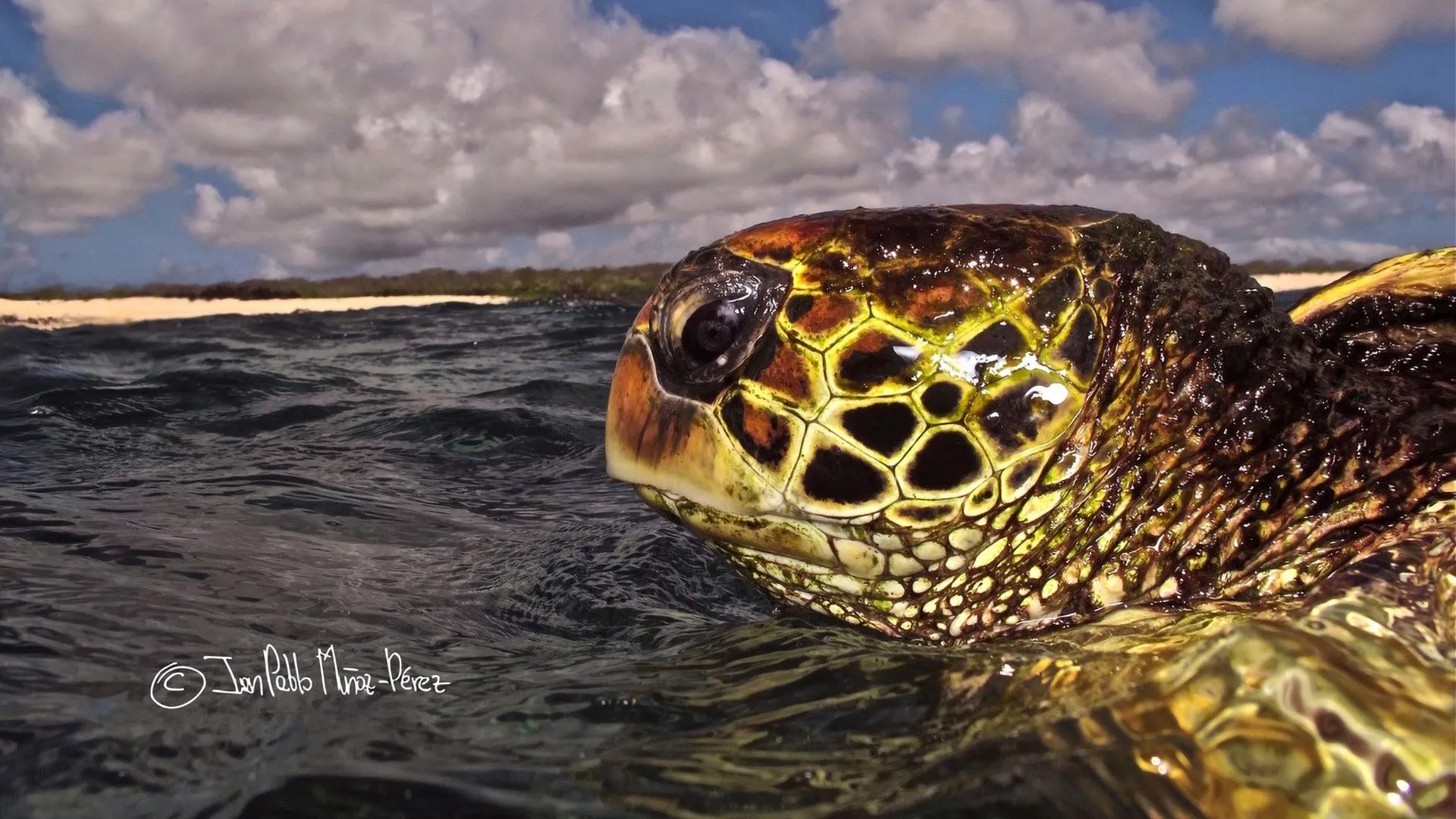
Sea turtles are known for extraordinary journeys across the ocean. They can navigate using cues from Earth's magnetic field, the sun, and ocean currents, traveling long distances to find food before eventually returning toward the places where they were born to reproduce. That reputation made one population in the Galápagos especially surprising.
Rather than roaming across vast stretches of ocean, these turtles appeared to spend much of their time close to home. "Here we show that 'yellow-morph' green sea turtles - one of two genetically distinct forms - occupy individual foraging areas which span one or more islands in the Galápagos. We expected them to migrate to distant beaches in the western Pacific to reproduce, yet interestingly, none of our satellite-tagged turtles even left the Galápagos Marine Reserve over the three years of our study," said Dr.
John W Rowe, a professor at Alma College in the United States and the corresponding author of a new study in Frontiers in Amphibian and Reptile Science. Green sea turtles stand apart from the other six living sea turtle species because adults are primarily vegetarian. Young turtles begin life eating both plants and animals, but as they mature, their diet shifts mainly to seagrasses and algae.
Scientists recognize two genetically distinct forms involved in this study. Yellow morph green sea turtles are generally found across tropical and subtropical parts of the western Pacific, while black morphs occur in the eastern Pacific west of the Americas and south of southern California. The Galápagos is the only known place where both forms share the same waters.
There, yellow and black morphs mingle and feed on the same types of marine vegetation. They are not completely alike, however. Young yellow morphs tend to grow more quickly than young black morphs, suggesting that there may be physiological differences between them that scientists have not yet fully characterized.
Rowe and his colleagues wanted to better understand where yellow morphs spend their time, how much territory they use, and whether they travel between islands within the 198,000 sq km Galápagos Marine Reserve. In 2015, the team carefully captured nine adults in shallow water near four islands. The group included seven males and two females.
Extract — continue reading at the source.


