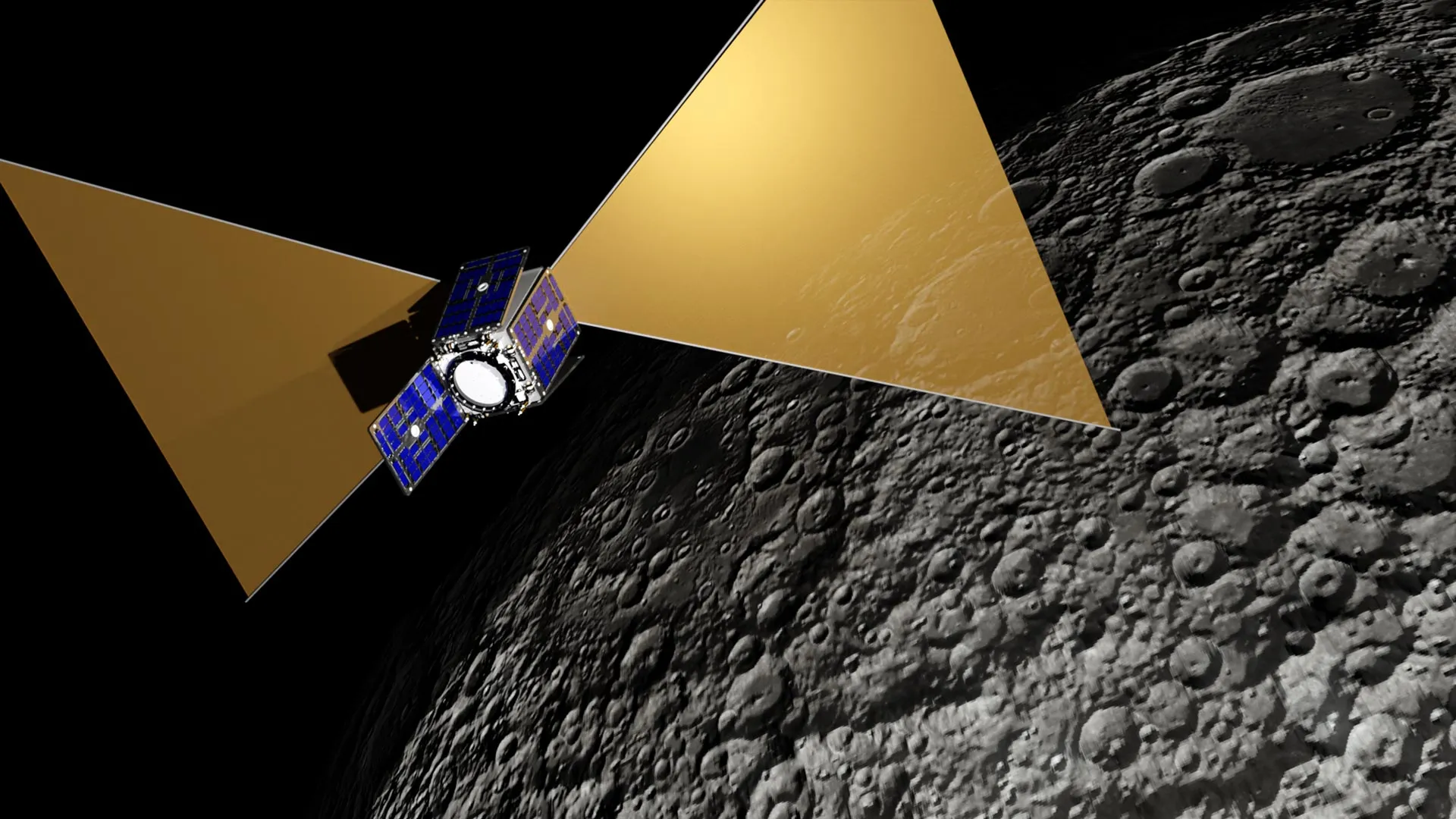
A satellite no bigger than a small carry on suitcase could help scientists investigate one of the least understood periods in cosmic history: the roughly 150 million years of darkness before the universe's first stars began to shine. Developed in the UK, the spacecraft is called CosmoCube. An international research team led by the University of Cambridge plans to send it around the Moon, where the lunar far side can block radio interference coming from Earth.
In that unusually quiet environment, CosmoCube will listen for an extraordinarily faint signal left behind by the early universe. Listening for a Signal From Before the First Stars Scientists call this signal the 21 centimeter line. It comes from hydrogen atoms that existed during the period between the lingering afterglow of the Big Bang and Cosmic Dawn, when nuclear fusion switched on inside the first stars.
No one has directly observed this chapter of cosmic history. The signal CosmoCube will seek originated more than 13.5 billion years ago, but detecting it from Earth is extremely difficult. Our planet's ionosphere prevents the relevant radio frequencies from reaching ground based observatories, while FM broadcasts, satellites and telecommunications produce additional interference that can overwhelm the faint cosmic signal.
When CosmoCube passes behind the Moon, the lunar body will block radio noise from Earth for about 40 minutes during each two-hour orbit. Over the spacecraft's expected two-year mission, researchers hope to collect about 1000 hours of observations from one of the final largely unexplored eras in the universe. Those measurements could help explain how the cosmos changed from a dark and relatively empty place into the rich universe of stars, galaxies and other structures seen today.
The project has received funding from the UK Space Agency, and researchers hope CosmoCube can launch within the next five years. Details of the mission have been published in Nature Astronomy. Searching for Dark Matter's Early Influence CosmoCube is designed to investigate more than the time before the first stars.
Researchers also hope its observations will shed light on dark matter and its influence on the formation of the earliest cosmic structures. Dark matter cannot be seen directly, but its gravitational effects are crucial for explaining how galaxies and other large structures hold together. "This emission from hydrogen after the Big Bang, but before the first stars, will hopefully allow us to understand the role of dark matter in the early universe, how it worked to pull together hydrogen into the first stars and galaxies," said lead author Professor Eloy de Lera Acedo from Cambridge's Cavendish Laboratory.
Extract — continue reading at the source.


