Southern California sits on one of the most active and closely watched fault networks in the United States. Earthquakes typically happen where sections of Earth's crust move against one another, become stuck, and slowly accumulate stress. When that stored energy is finally released, the result can be an earthquake.
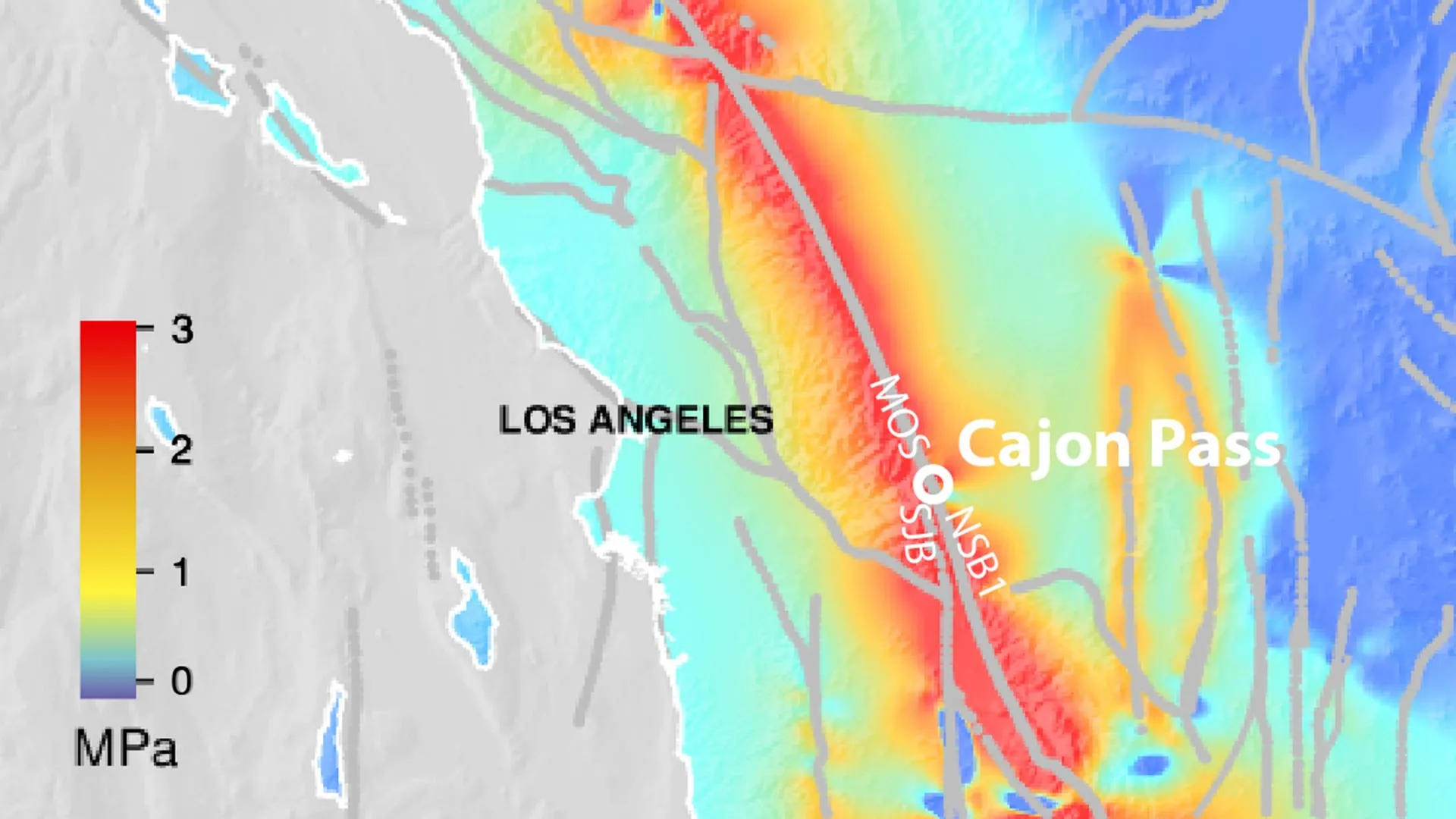
Two of the most important fault systems in Southern California are the San Andreas and San Jacinto faults. Together, they accommodate much of the tectonic motion in the region. Northeast of Los Angeles, the two systems come close together at Cajon Pass - a complicated geological junction where a rupture traveling along one fault may, under the right conditions, continue onto the other.
That possibility matters because the broader Los Angeles region has not experienced a comparable major earthquake since the magnitude 7.9 Fort Tejon earthquake in 1857. During that long quiet period, tectonic stress has continued to build along parts of the fault system, raising longstanding questions about how a future large rupture might unfold. California fault stress reaches extreme levels A new study led by Dr.
Liliane Burkhard of the Division of Space Research and Planetary Sciences (WP) at the Physics Institute of the University of Bern has now taken a much longer view of that risk. An international team modeled roughly 1,000 years of earthquake activity along the southern San Andreas and San Jacinto fault systems to estimate the amount of stress currently concentrated around Cajon Pass. The research also involved scientists from the University of Hawaiʻi at Mānoa, the U.S.
Geological Survey Earthquake Science Center in Pasadena and the Scripps Institution of Oceanography at UC San Diego. Their results suggest that tectonic stresses in parts of the system have reached, and in some locations surpassed, the highest values found anywhere in the model's 1,000-year history. The researchers also describe Cajon Pass as an "earthquake gate": a fault junction that may help determine whether a large earthquake remains limited to one fault or continues across both fault systems.
The study has just been published in Journal of Geophysical Research: Solid Earth. To reconstruct how stress changed over centuries, the researchers developed a physics-based, four-dimensional earthquake cycle model. In practical terms, the model simulates what happens across three dimensions of space while also tracking how the fault system changes through time.
Extract — continue reading at the source.