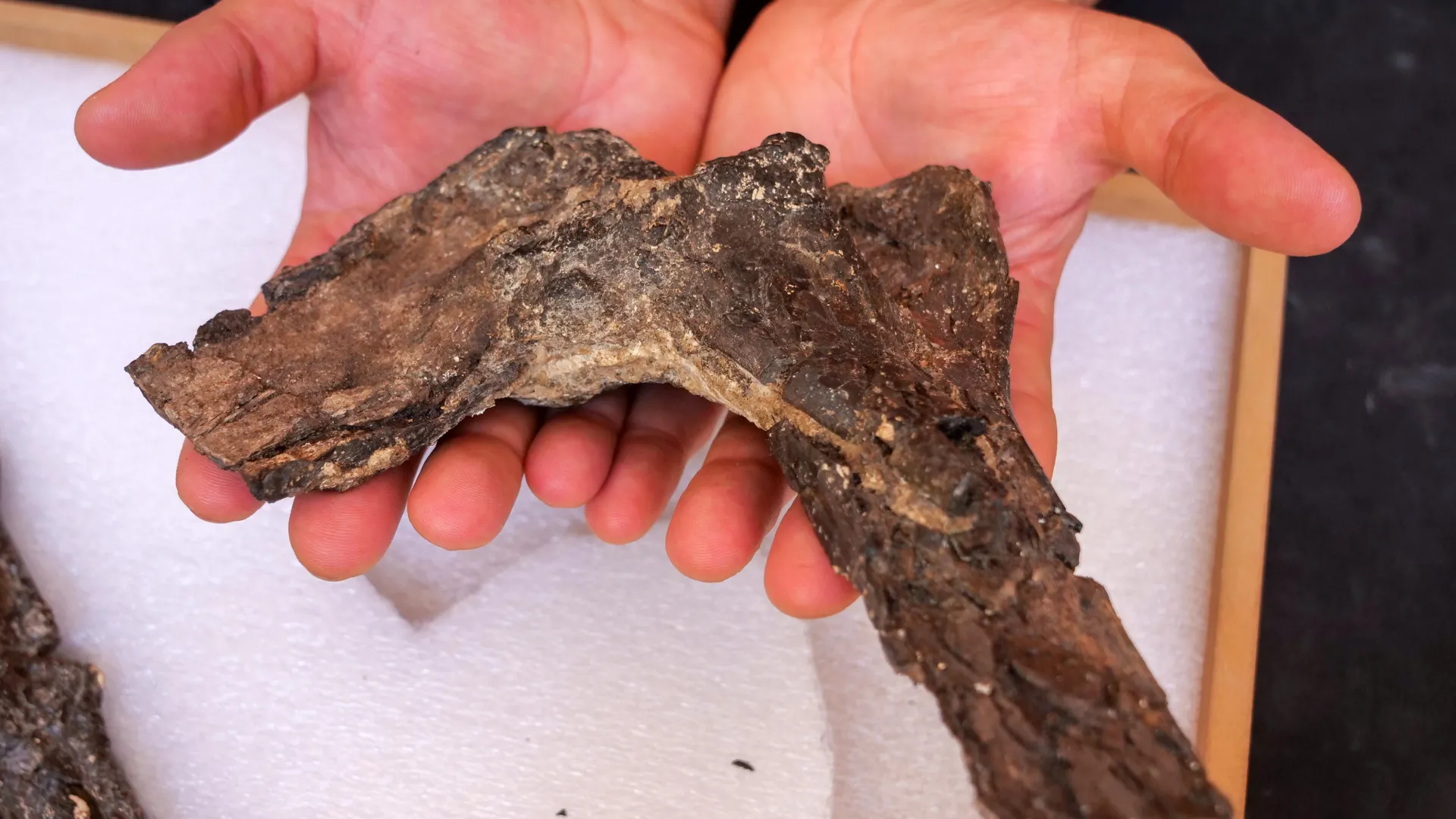
Scientists have discovered remarkably preserved traces of dinosaur blood inside 115-million-year-old bones, revealing that delicate biological molecules can survive far longer than previously believed. The breakthrough could transform how researchers study prehistoric animals and even influence the search for ancient life beyond Earth. An international team led by Curtin University found fossilized red blood cells and chemical evidence of blood molecules in the remains of Aratasaurus museunacionali, a meat-eating theropod dinosaur discovered in northeastern Brazil.
The findings, published in the Proceedings of the National Academy of Sciences, also include amino acids associated with collagen, an important structural protein found in bones and other connective tissues. The discovery provides the first definitive chemical confirmation of molecules derived from hemoglobin inside fossilized dinosaur red blood cells. Earlier research had identified structures resembling blood cells in ancient fossils, but scientists had not conclusively demonstrated the presence of these particular molecular remains within them.
Ancient Dinosaur Blood Preserved Inside Fossilized Bones When researchers examined the dinosaur's limb bones, they identified numerous mineralized red blood cells inside vascular canals, the tiny passages that once contained blood vessels. Chemical analysis revealed preserved heme molecules, which are components of hemoglobin, the protein that allows red blood cells to transport oxygen. Finding these molecules provided direct chemical evidence that the fossil contained remnants of ancient blood.
It also demonstrated that some biological materials once thought too fragile to survive for millions of years can remain detectable under exceptional conditions. The study was led by John Curtin Distinguished Professor Kliti Grice, founding director of Curtin University's WA-Organic and Isotope Geochemistry Centre and an Australian Research Council Laureate Fellow. "To detect intact heme-derived molecules in 115-million-year-old red blood cells is astonishing: this really is a landmark discovery," Professor Grice said.
"It not only extends the known fossil record of blood, but also offers a direct molecular window into the physiology of long-extinct animals so we may better understand them and the world they lived in." How Dinosaur Blood Survived 115 Million Years The extraordinary preservation appears to be connected to a mineral called hausmannite. This mineral helped stabilize the fossilized blood cells and preserve their molecular components (including amino acids of collagen) over an immense span of geological time. In effect, the mineral created a natural time capsule that protected microscopic evidence of the dinosaur's biology long after its death.
Researchers believe the conditions surrounding the dinosaur's burial were also crucial. They suspect the animal was quickly covered by sediment in an environment with little oxygen and abundant microbial activity. These conditions may have helped preserve biological material that would ordinarily have broken down and disappeared.
Extract — continue reading at the source.


