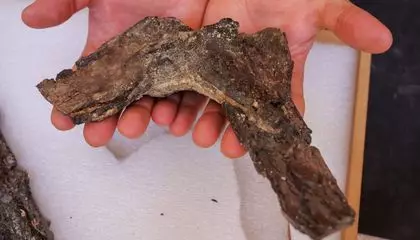
Scientists say they’ve discovered blood inside a 115-million-year-old dinosaur bone. That’s backed by their detection of heme, an iron-rich molecule in hemoglobin, the protein in red blood cells that carries oxygen and gives blood its red color. The findings, described November 2 in the Proceedings of the National Academy of Sciences, potentially represent the oldest red blood cells ever found in a dinosaur fossil.
Grice and colleagues made their discoveries while analyzing a hind leg bone of an Aratasaurus museunacionali, a small, bipedal, meat-eating dinosaur that lived during the Cretaceous period. This individual is believed to have been about 4 years old when it died; it wasn’t yet fully grown, weighing an estimated 75 pounds and measuring about 10 feet long. Discovered in a mine in northeastern Brazil in 2008, the fossil eventually went to the country’s National Museum in Rio de Janeiro.
In 2024, experts sent it to Grice and colleagues, who had agreed to investigate the specimen. The scientists did that by first slicing off thin sections, then using hydrochloric acid to remove the surrounding rock. In 2018, a fire destroyed millions of objects in Brazil’s National Museum—the oldest national history museum in the Americas.
A. museunacionali’s name is a combination of Greek and the Indigenous Brazilian language Tupi that translates to “the dinosaur born from the National Museum fire.” When they looked at the fossil slices under a high-resolution microscope, they spotted numerous structures that resembled red blood cells. The blobs were round with sunken centers, each measuring about 23 micrometers long by 20 micrometers wide. Additionally, they were located inside vascular canals—the channels that carried blood vessels through the bone while the animal was alive.
These tests revealed two chemical fingerprints of heme, including a degraded form of the molecule that hints at its ancient origins. When they performed similar analyses on the sediment surrounding the fossil, they got very different results. They mostly found evidence of plants and bacteria, with only small traces of heme.
This, the researchers say, suggests the fossilized bone samples were not contaminated. Additionally, the scientists compared the structures to the blood cells of birds and crocodiles, the closest living relatives of dinosaurs. The A. museunacionali cells were longer and wider than the bird and crocodile blood cells.
Extract — continue reading at the source.