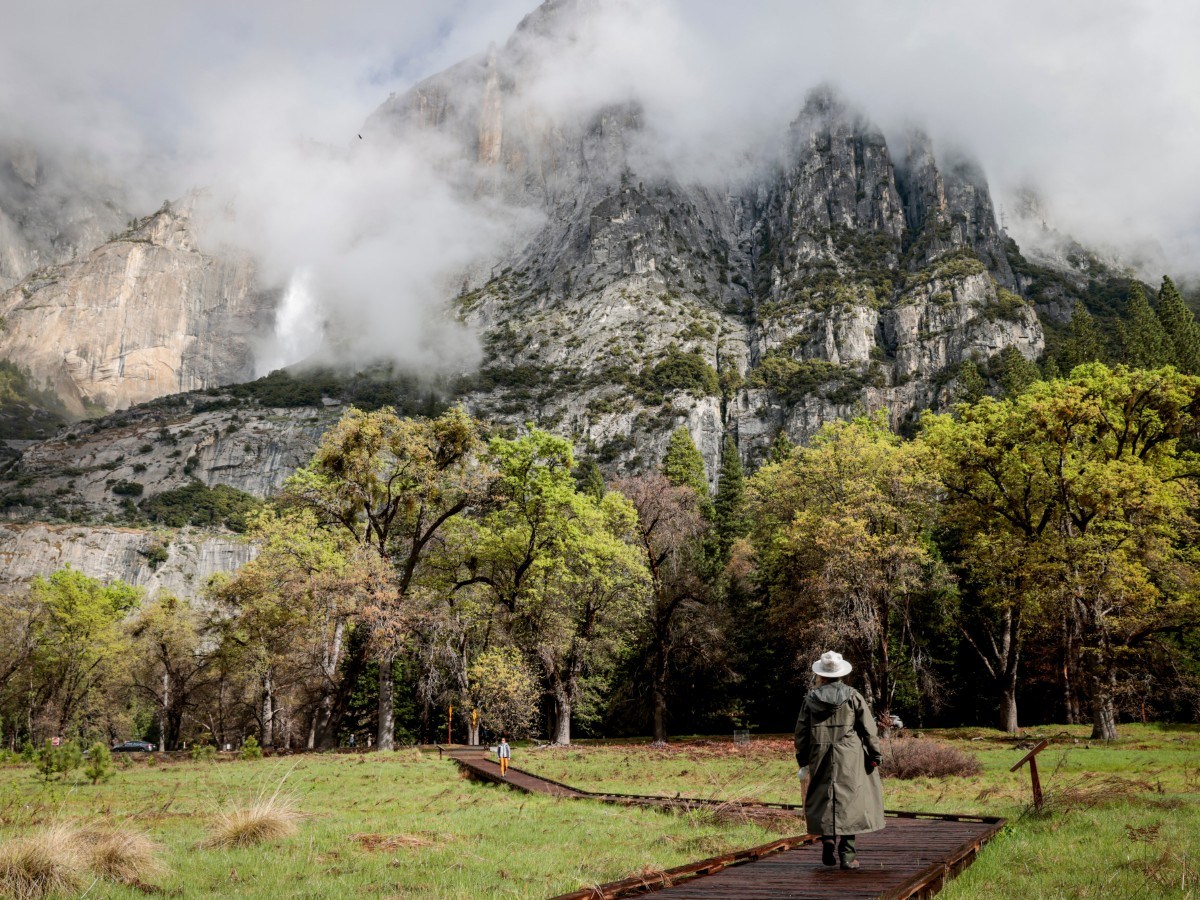
Yosemite National Park’s famous meadows – which are crucial for the park’s ecosystem and wildlife – are struggling, and researchers are attempting to restore the land before it’s too late. Experts at Colorado State University planted 40,000 sedge seedlings in the Tuolumne Meadows in the hope that bringing native plants back to the area would improve soil health. "Tuolumne meadows is declining because the native dominant plant species that should form a dense sod is uncommon due to historical disturbances – most likely very heavy sheep grazing in the late 1800s that removed the key plant species," lead author David Cooper, a senior research scientist at Colorado State University, told Newsweek.
The team believes that the sheep’s overgrazing could be why the soil quality has degraded, resulting in the meadow releasing carbon. Cooper explained that the "carbon is needed to maintain soil water holding capacity and support plant growth. At present the decomposition of soil organic matter and loss of carbon far exceed plant production resulting in this net loss of soil carbon each year." He said that the loss of soil organic matter can lead to the "drying of the meadow, making it susceptible to conifer tree invasion and the loss of meadow function and views that visitors come to experience." The researchers therefore planted the sedge seedlings because they "shade the meadow soil and its roots and rhizomes provide the organic carbon that builds the meadow soil," Cooper said.
Three years after planting of seedlings, the Colorado State University researchers discovered that while soil health was improving, the meadow was still releasing carbon as organic soil matter continued to decompose. They said this suggested recovery of the meadow is possible, but it will take time, given the damage has been ongoing for about 150 years. They currently estimate it will require around 25 to 30 years of restoration work.
Their work was published in the Journal of Geophysical Research: Biogeosciences on October 6. Christine Sprunger, an associate professor of soil health at Michigan State University, told Newsweek that it is "an ambitious restoration effort, and it is encouraging that the researchers are seeing early signs of improved soil health after just three years." "Restoring vegetation is an important first step, but rebuilding the soil processes that sustain a healthy meadow takes longer. Continued carbon losses underscore how difficult it can be to reverse the effects of historical degradation," she added.
Randall Jackson, a professor of grassland ecology at the University of Wisconsin-Madison, told Newsweek that restoring the function of ecosystems is a "critical part of planetary health and wellbeing." "I applaud this effort to restore vegetation that might result in higher water holding capacity and soil organic matter accumulation, which are important for reducing flooding, improving water quality, and helping stabilize climate while enhancing biodiversity," he added. He said that well-functioning wetlands, including most grassland ecosystems, "historically accumulated and retained carbon (i.e., organic matter), so the fact that these wetlands have been losing carbon to the atmosphere and contributing to climate change is a problem for everyone." "It reflects a broader problem that we’ve observed in grasslands of the Midwest, that most of the tallgrass prairie, mostly in annual row crops for the past 150 years, are losing soil carbon to the atmosphere as the climate warms, which no amount of management (e.g. changing vegetation or disturbance regimens) is likely to reverse," he said. Sprunger said that restoring native sedges could "help rebuild the processes that historically sustained these meadows." "Their extensive root systems contribute organic matter below ground, help hold soil in place, and support soil organisms, including microbes and free-living nematodes," she said.
She explained that these organisms help "process plant inputs and cycle nutrients." "Some plant-derived carbon may eventually become stabilized in the soil," she continued, "but the amount retained depends on the balance between new carbon inputs and losses through decomposition and erosion." She added that "continued restoration and long-term monitoring are essential," as, while three years could reveal whether plants are establishing, it is "a short window for evaluating soil carbon recovery." Instead, she said that "monitoring over a decade or longer would help determine whether early improvements translate into sustained carbon storage." Joseph Blankinship, an associate professor of agricultural and life sciences at the University of Arizona, told Newsweek that this is an "encouraging effort" because it addresses a fundamental part of meadow recovery – rebuilding the living root systems – but he said that "restoring vegetation is only the beginning." "A meadow can start recovering biologically before it stops losing carbon," he said. He added that it is also "important to quantify not just the new carbon from introduced plants but also the stability of 'old' carbon that has been there for centuries or longer," and to "understand effects of restoration on water dynamics (for example, soil water-holding capacity) deep in the soil profile." "I would recommend tracking plant establishment, groundwater, soil carbon, and greenhouse-gas exchange against unplanted controls," he said. "Success should also include habitat, erosion control, and water-related functions—not solely whether the meadow has already become a carbon sink." Ultimately, Jackson said that bringing past vegetation back to the meadows may "slow the loss of soil carbon by improving sensitive soil health indicators, but whether it will reverse it and make the meadows an atmospheric carbon sink as the climate continues to warm is a long-term question that will require decades of monitoring to determine." Cooper, D et al. (2026) Can the C
Extract — continue reading at the source.