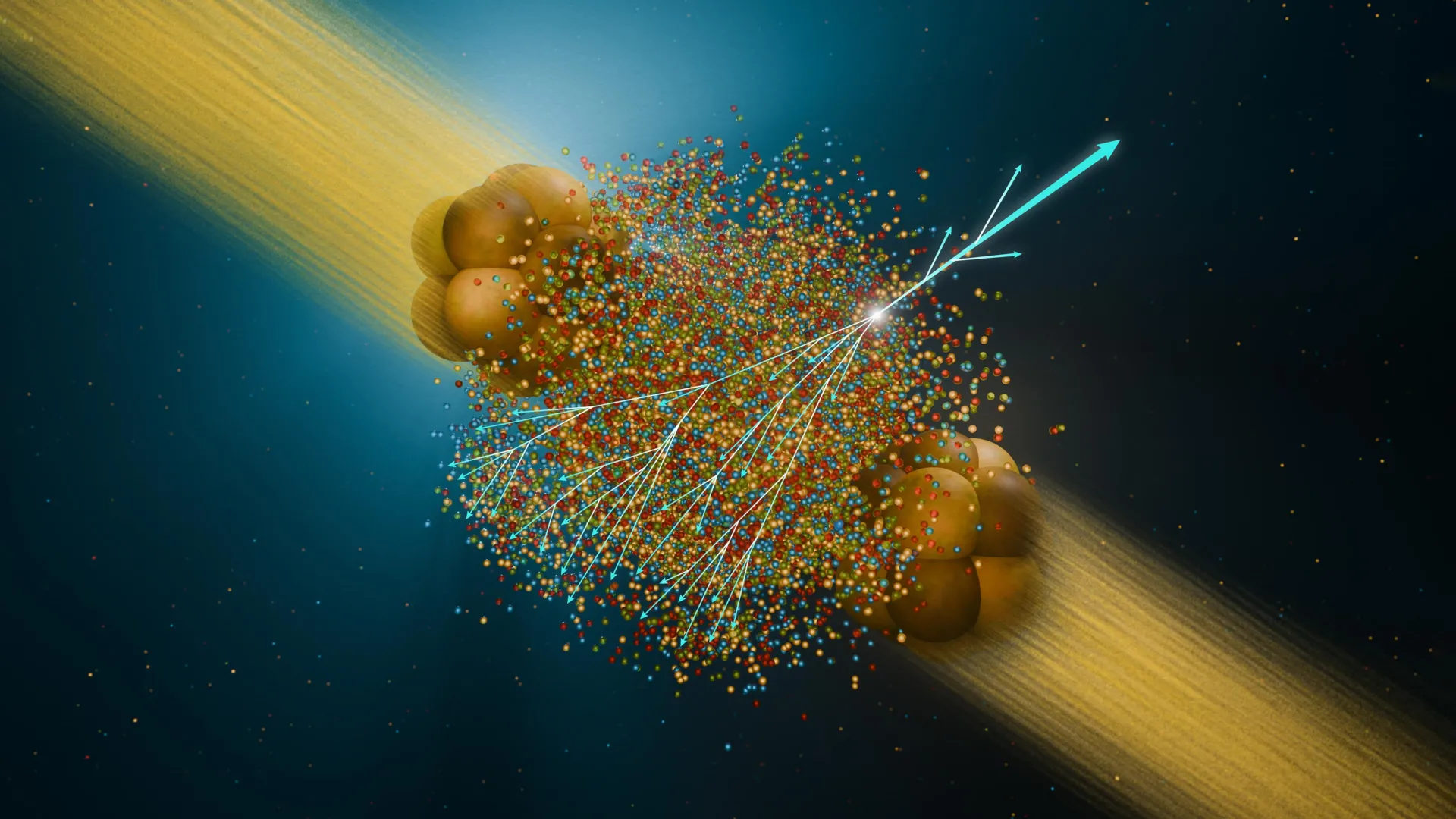
New findings from the STAR experiment at the Relativistic Heavy Ion Collider (RHIC) suggest that scientists can recreate an extraordinary form of matter from the earliest moments of the universe using surprisingly small atomic collisions. By smashing oxygen nuclei together at nearly the speed of light, researchers have uncovered strong evidence of quark-gluon plasma (QGP), an extremely hot and dense state of matter that existed shortly after the Big Bang. The findings, published in Physical Review Letters, reveal that high-energy streams of particles lose energy as they travel through the material created by these collisions.
This effect, called jet quenching, provides an important clue that quark-gluon plasma has formed. Scientists have previously observed jet quenching in collisions involving much larger atomic nuclei at RHIC, a U.S. Department of Energy (DOE) Office of Science User Facility that operated at Brookhaven National Laboratory from 2000 until 2026.
The same effect has also been detected in oxygen collisions at CERN's Large Hadron Collider (LHC), the European Particle Physics Laboratory. What makes the new RHIC findings especially significant is that the oxygen collisions occurred at substantially lower energies. The results establish a new lower boundary for the conditions known to produce quark-gluon plasma in this small collision system, helping scientists narrow down what it takes to create matter resembling that of the infant universe.
"The QGP is believed to be the form of matter that filled the early universe -- before the protons and neutrons that make up today's atoms formed. Understanding its properties is essential for uncovering how the early universe evolved in its first microseconds," said Li Yi, a professor of physics at Shandong University who oversaw the STAR analysis. "One of the most powerful ways scientists study the QGP is by identifying where its signatures appear -- and just as importantly, where these signatures turn off," she said.
Rongrong Ma, a STAR physicist at Brookhaven Lab, explained why investigating smaller collisions is so valuable. "This analysis is pushing the boundaries to an extreme case to help us learn something about this jet quenching phenomenon and the conditions needed to generate a QGP." How Scientists Recreate Matter From the Early Universe RHIC was designed specifically to produce and investigate quark-gluon plasma. Traditionally, researchers have accomplished this by accelerating gold nuclei to enormous speeds and crashing them into one another.
Each gold nucleus contains 79 protons and 118 neutrons. When two such nuclei collide with sufficient energy, the boundaries of their protons and neutrons effectively break down, releasing the quarks and gluons inside them. The tremendous energy of the impact also generates thousands of additional quarks and gluons through the conversion of energy into matter, as described by Einstein's famous equation, E=mc2.
Extract — continue reading at the source.