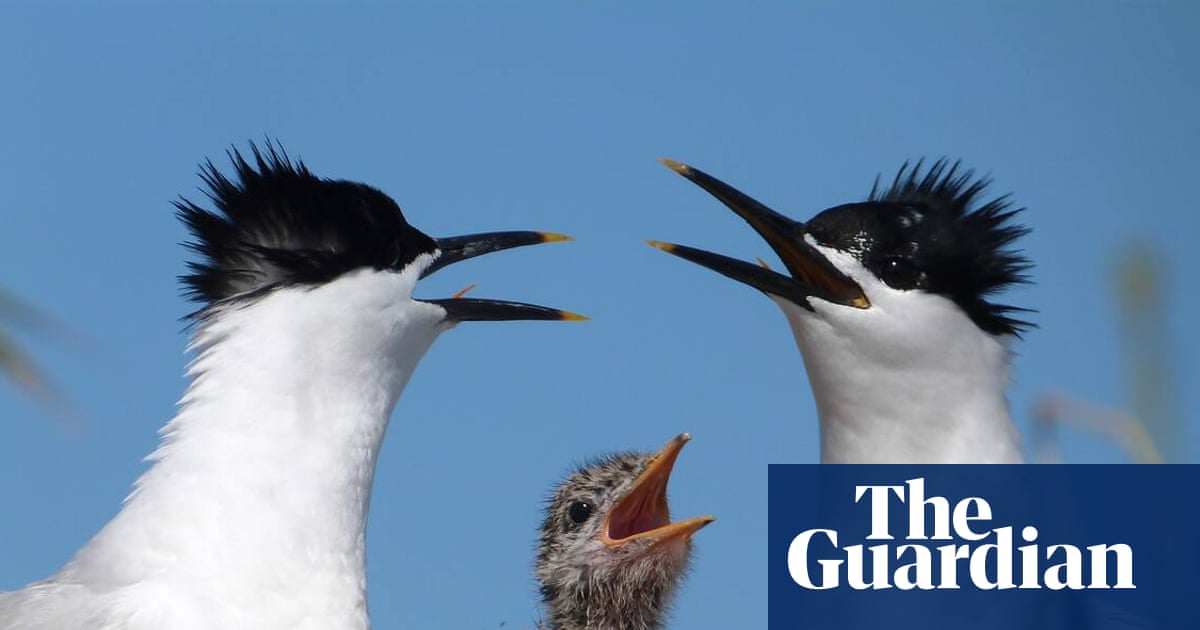
The colony of sandwich terns nesting at Pagham harbour, West Sussex, was completely wiped out by bird flu in 2022. But numbers have bounced back from zero to 756 breeding pairs in just three years after conservation work in the Solent. Populations of breeding little terns, ringed plovers, oystercatchers and black-headed gulls have also increased along the same coastline.
The turnaround comes thanks to work by RSPB staff and volunteers at the Pagham harbour nature reserve and similar efforts across 52,000 hectares (128,000 acres) of coastline and estuary between the south coast and the Isle of Wight. The sandwich terns produced 570 fledglings at Pagham harbour this summer, one of the largest colonies ever recorded in the Solent region. Numbers of black-headed gulls increased 10-fold from 51 fledglings in 2025 to 504 in 2026, while little terns were up from 21 last year to 34.
Avocets also prospered, with 18 pairs nesting on newly created islands within a saline lagoon at Ferry Pool, which provided safer nesting areas for shoreline birds. Other conservation work included special fencing to exclude mammalian predators of ground-nesting birds such as foxes, monitoring for the presence of rats, in-person patrols to reduce predation and the selective removal of vegetation to make space for shorebirds to nest. Wez Smith, senior project manager for the RSPB, said: “In 2022, sandwich terns, black-headed gulls and Mediterranean gulls were hit severely by HPAI/bird flu, leading to the abandonment of their breeding colony at Pagham harbour.
It’s taken several years of dedicated conservation action, but the situation began to ‘tern’ around last year, and the site is now thriving with record breaking populations using it.” Volunteers and rangers have also carried out patrols to raise awareness among visitors and local people of the vulnerability of ground-nesting birds to disturbance, with dog-friendly exercise areas provided away from the nesting birds. At nearby RSPB Medmerry, floating rafts for nesting birds have provided predator-free spaces for common terns and black-headed gulls to nest without being disturbed by dogs or boats, while rafts have also boosted common tern breeding numbers at West Hayling, another RSPB coastal reserve in Hampshire. The efforts are part of the Solent Seascape project, a long-term partnership of charities and institutions led by Blue Marine Foundation to restore coastal nesting sites, seagrass beds, oyster reefs and saltmarsh along the coast.
Extract — continue reading at the source.