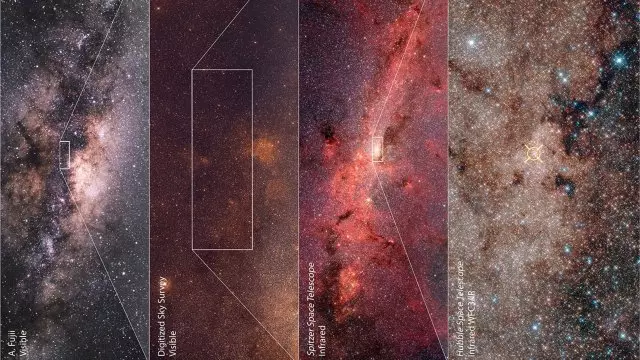
The right kind of telescope can get us to our central black hole. But it took something extra to go all the way to seeing its event horizon. This multi-wavelength and multi-telescope view of the Milky Way shows it at a variety of zoom levels (L-R, from most zoomed-out to most zoomed-in) and in a variety of wavelengths, from dust-rich visible light views to infrared views that are transparent to the dust, enabling astronomers to identify otherwise obscured stellar sources.
Larger telescopes at longer wavelengths are the key to zooming in all the way to the galactic center itself, where the central supermassive black hole, Sagittarius A*, can be located. . Levay (STScI); Acknowledgment: NASA, ESA, A. Fujii, Digitized Sky Survey (DSS), STScI/AURA, Palomar/Caltech, UKSTU/AAO, NASA/JPL-Caltech/S.
Stolovy (Spitzer Science Center/Caltech), the Hubble Heritage Team (STScI/AURA), T. Bajaj (STScI) At the centers of galaxies, supermassive black holes reside. This image of the central region of galaxy Messier 87 comes in the X-ray, via NASA’s Chandra X-ray observatory.
The central, supermassive black hole is blasting out energetic particles at 99%+ the speed of light, which produces X-rays visible for up to 18,000 light-years from the galactic center. It is often easier to see these features in extragalactic objects than in our own galaxy, due to the large amount of obscuring material present within our own galaxy. But seeing into the Milky Way’s heart, especially from within it, presents challenges.
Even the Milky Way, a relatively quiet galaxy with a relatively small central supermassive black hole, exhibits giant geysers of charged particles emanating from the galactic center. They can be revealed by radio telescopes, such as this image constructed with data from the Parkes radio telescope, a.k.a. Carretti (CSIRO), S-PASS Team, E.
Bressert (CSIRO) Our galactic plane is rich in dust and gas: opaque to optical wavelengths. The European Space Agency’s space-based Gaia mission has mapped out the three-dimensional positions and locations of more than one billion stars in our Milky Way galaxy: the most of all-time, as well as many stars in sufficiently nearby galaxies. Looking toward the center of the Milky Way, Gaia reveals both light-blocking and luminous features that are scientifically and visually fascinating.
Extract — continue reading at the source.